


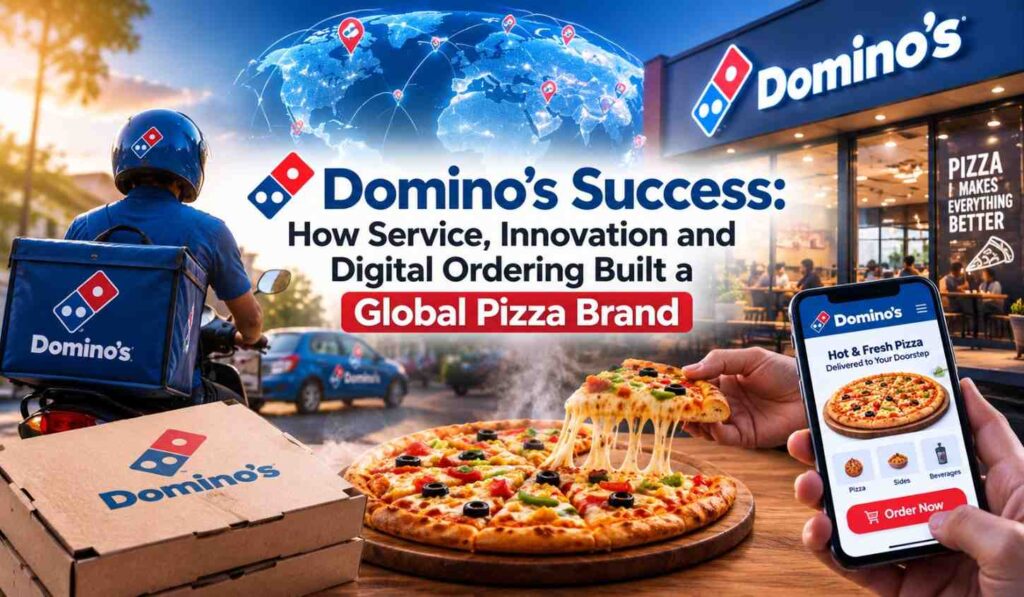
From a single pizza store in Michigan to more than 22,100 locations worldwide, Domino’s has built one of the most recognizable names in the global quick-service restaurant industry.
The story began in 1960 when brothers Tom and James Monaghan took over a small pizza store called DomiNick’s in Ypsilanti, Michigan, USA. Tom Monaghan later became the sole owner, and in 1965, the business adopted the name Domino’s Pizza.
More than six decades later, Domino’s has evolved from a small local pizza business into a global brand operating across more than 90 international markets.
Its long-term success can be attributed to several factors, including a franchise-driven expansion strategy, convenient delivery, standardized operations, menu innovation, digital ordering technology and a strong focus on customer experience.
How Domino’s Started Its Journey in 1960
Domino’s had a relatively modest beginning. What started as one pizza store gradually developed into a scalable business model focused heavily on delivery and operational efficiency.
An interesting part of Domino’s history is its famous three-dot logo. The three dots represent the first three Domino’s stores operating when the logo was created.
According to the commonly told story behind the brand, there was originally an idea to add another dot whenever a new store opened. However, Domino’s expanded so rapidly that such a plan would quickly have become impractical.
The three-dot design ultimately remained and became an internationally recognized part of the Domino’s brand identity.
From One Store to a Global Pizza Network
Domino’s expansion accelerated through franchising.
By 1978, the company had reached 200 stores, and in 1983, Domino’s opened its first international location in Winnipeg, Canada. Its international footprint continued to expand rapidly during the following decades.
Today, Domino’s describes itself as the world’s largest pizza company based on global retail sales. As of December 28, 2025, the Domino’s system included more than 22,100 locations across more than 90 markets worldwide.
This scale demonstrates how a relatively simple pizza delivery concept became a highly developed international franchise network.
A major reason behind this expansion has been Domino’s ability to combine global brand consistency with localized menus and franchise operations suited to individual markets.
India Has Become One of Domino’s Most Important Markets
India has played a particularly important role in Domino’s international growth story.
According to Domino’s 2025 annual reporting, India was its largest international market by store count, with approximately 2,396 stores as of December 28, 2025.
Domino’s in India is operated primarily through Jubilant FoodWorks, which has helped the brand expand beyond major metropolitan areas into a growing number of smaller cities and emerging markets.
Localization has also contributed to its popularity.
Rather than relying exclusively on menu items developed for Western markets, Domino’s India has offered products designed around local tastes and preferences, including vegetarian choices and Indian-inspired flavors.
This combination of localization, accessibility, delivery convenience and competitive pricing has helped Domino’s establish a substantial presence in India’s quick-service restaurant market.
How Service Excellence Contributed to Domino’s Success
Domino’s success cannot be explained by pizza alone.
A central part of its business model has been making ordering and receiving food as convenient as possible.
Over the years, the company has invested in operational systems designed to improve order accuracy, preparation, delivery and customer convenience.
Its service model is built largely around two channels:
- Delivery
- Carryout or takeaway
This focused model allows many Domino’s stores to operate differently from traditional full-service restaurants.
Standardized preparation processes, franchise systems, supply-chain capabilities and technology have also helped the company deliver a relatively consistent customer experience across thousands of locations.
Digital Ordering Changed the Domino’s Customer Experience
One of the biggest changes in Domino’s history has been its transition from a primarily telephone-based pizza delivery company into a digitally enabled food-ordering business.
Domino’s introduced online and mobile ordering in the United States in 2007.
In 2008, it introduced Domino’s Tracker, allowing customers to follow different stages of their order digitally.
These innovations reflected an important change in consumer behavior: customers increasingly wanted faster, simpler and more transparent ways to order food.
Today, customers in many markets can place orders through websites and mobile apps, select delivery or takeaway options, make digital payments, browse available deals and track eligible orders.
Digital ordering has made the customer journey considerably more convenient compared with the traditional process of calling a restaurant to place an order.
Why Domino’s Online Offers Became So Popular
Discounts and promotional offers have become another important element of Domino’s digital strategy, particularly in price-sensitive markets such as India.
Customers can often find different types of promotions, including:
- Pizza combo deals
- Everyday-value offers
- Limited-period discounts
- Online promotional offers
- App-specific deals
- Coupon-based discounts on eligible orders
The exact offers, prices and terms can change according to location, date, restaurant availability and ordering channel.
The popularity of online deals is easy to understand. Customers can browse the menu, compare available offers, customize their food and complete an order without having to contact the restaurant directly.
This combination of convenience and perceived value encourages customers to use digital ordering channels repeatedly.
More Than Discounts: Why Domino’s Digital Strategy Works
Coupons may encourage customers to place an order, but discounts alone do not explain Domino’s long-term success.
The broader digital experience is equally important.
A customer ordering online generally expects a straightforward process: choose a nearby store, browse the menu, customize the order, check available offers, pay conveniently and receive updates about the order.
Reducing friction at each stage can improve customer satisfaction and encourage repeat purchases.
Domino’s recognized relatively early that technology could become part of the restaurant experience rather than simply an additional ordering channel.
That approach has helped position the company as both a food brand and a technology-driven delivery business.
Menu Localization Helped Domino’s Grow Internationally
Another important lesson from Domino’s expansion is the value of localization.
Food preferences vary significantly between countries and even between regions within the same country.
In India, vegetarian food preferences and demand for familiar local flavors have influenced the development of pizza menus. Domino’s has adapted its offerings with products designed specifically for Indian consumers rather than simply reproducing its U.S. menu.
Localization can help an international restaurant brand remain globally recognizable while still feeling relevant to local customers.
This strategy is particularly important in a diverse food market such as India.
Innovation Has Been a Consistent Part of the Brand’s Growth
Domino’s history includes several important milestones that demonstrate its willingness to evolve.
The company opened its first international store in 1983, introduced online and mobile ordering in 2007, launched Domino’s Tracker in 2008 and redesigned its logo and store concept in 2012.
Over time, Domino’s has also experimented with new delivery technologies, electric delivery vehicles, digital ordering platforms and other operational innovations.
Not every innovation is available in every country, but the overall strategy is clear: Domino’s has consistently explored ways to make ordering, preparation and delivery more efficient.
What Businesses Can Learn From Domino’s Success
The Domino’s story offers several practical lessons for businesses operating in competitive consumer markets.
First, convenience can be a major competitive advantage. A good product is important, but customers also value how easily they can discover, purchase and receive it.
Second, technology should solve real customer problems. Online ordering, mobile apps and order tracking became valuable because they simplified the purchasing experience.
Third, localization matters when expanding internationally. Businesses that understand regional tastes, pricing expectations and consumer behavior are better positioned to connect with local markets.
Finally, a strong brand must continue evolving. Domino’s has operated for more than 65 years, but its business today is significantly different from the small pizza store that started in Michigan in 1960.
The Future of Domino’s
The food-delivery industry continues to evolve as customers expect greater convenience, competitive pricing, faster service and seamless digital experiences.
For Domino’s, future growth is likely to depend on maintaining strong franchise operations while continuing to improve digital ordering, delivery efficiency, menu relevance and customer value.
Its large international footprint also creates opportunities for continued expansion, particularly in markets where organized quick-service restaurants and online food ordering are still growing.
However, scale also creates challenges. Domino’s must maintain consistent food quality, customer service and operational standards across thousands of franchise locations while responding to changing consumer preferences and strong competition.
Conclusion
Domino’s journey from a single Michigan pizza store in 1960 to more than 22,100 locations across over 90 markets is an example of how service, franchising, technology and localization can work together to build a global brand.
The company’s success has not come from discounts or pizza delivery alone. Its ability to adapt to changing customer expectations-from telephone orders to online ordering, mobile apps and digital order tracking-has played an important role in its growth.
India is now particularly significant to this story, becoming Domino’s largest international market by store count as of the end of 2025.
More than 65 years after its founding, Domino’s demonstrates an important business principle: long-term success requires more than a recognizable product. It requires consistent service, operational discipline, technological adaptation and a willingness to evolve with customers.
Frequently Asked Questions
Domino’s traces its history to 1960, when brothers Tom and James Monaghan took over a pizza store called DomiNick’s in Ypsilanti, Michigan. The Domino’s name was adopted in 1965.
The three dots traditionally represent the first three Domino’s stores operating when the logo was created.
According to Domino’s 2025 annual reporting, the company had more than 22,100 locations across more than 90 markets worldwide as of December 28, 2025.
Domino’s reported 2,396 stores in India as of December 28, 2025, making India its largest international market by store count at that time.
Its growth in India can be attributed to factors including an extensive store network, localized menu options, vegetarian choices, digital ordering, delivery convenience, promotional pricing and expansion into a wide range of Indian cities.
Yes. Domino’s India provides various deals, promotional offers and coupons through its official digital ordering channels. Offers and eligibility can change depending on the location, date and applicable terms.
According to the company’s official history, Domino’s introduced online and mobile ordering in the United States in 2007 and launched Domino’s Tracker in 2008.
Domino’s identifies itself as the world’s largest pizza company based on global retail sales. As of the end of 2025, its network included more than 22,100 locations in over 90 markets.