


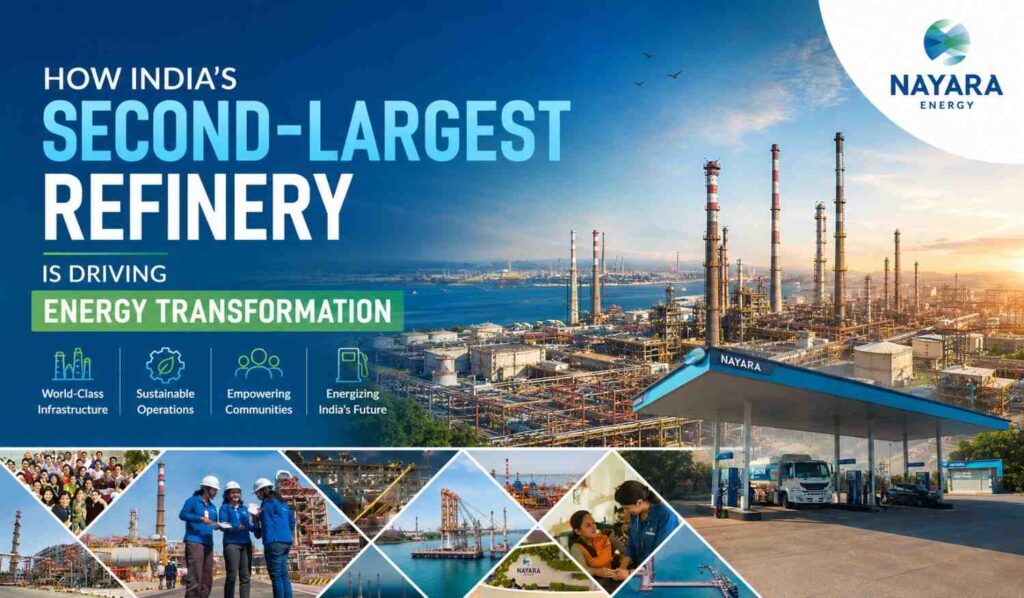
India’s appetite for oil keeps growing, and so does the pressure on domestic refiners to keep pace without compromising on safety, sustainability, or community impact. Nayara Energy operates a 400,000-barrels-per-day refinery at Vadinar, Gujarat, making it one of the most important single-site refining assets in the country. Formerly known as Essar Oil, the company carries more than five decades of refining experience and has reinvented itself as a modern, technology-driven energy player.
This article looks at how Nayara Energy has evolved – from its ownership restructuring to its latest 2026 operational milestones – and why it continues to matter for India’s energy security.
From Essar Oil to Nayara Energy: A Quick Background
In 2017, Essar Oil was acquired in a nearly $13 billion deal by a consortium led by Russia’s Rosneft, along with Trafigura and the UCP Investment Group – one of the largest FDI transactions in India’s history at the time. The rebranded entity, Nayara Energy, inherited the Vadinar refinery complex and set out to modernize operations while expanding its retail and logistics footprint.
Nayara Energy accounts for roughly 8% of India’s total refining capacity and around 7% of the country’s retail fuel network, alongside a growing petrochemicals portfolio. Today, Rosneft holds a 49% stake in the company.
2026 Update: Nayara Completes Major Refinery Turnaround Amid Global Headwinds
The most significant recent development is Nayara’s scheduled 2026 turnaround at Vadinar – a planned shutdown for deep maintenance, inspection, and upgrades. The refinery was taken offline starting April 9, 2026 for planned maintenance and resumed operations after completion.
The scale of this operation underscores how seriously Nayara treats operational reliability:
- More than 34,000 personnel were involved, supported by approximately 480 pieces of heavy equipment, including 180 cranes
- Peak onsite workforce exceeded 35,000 people, coordinated through AI-based workforce movement management systems
- Nearly 450,000 meals were served during the exercise, along with extensive cooling arrangements for workers in high-temperature conditions
- Drone-enabled safety communication and task-specific training were used to reinforce safety protocols throughout
Importantly, Nayara maintained uninterrupted fuel supply to customers nationwide throughout the shutdown, relying on coordinated logistics and inventory planning – a notable feat given the scale of the maintenance work.
Beyond routine upkeep, the company used the shutdown to roll out value-enhancement projects aimed at improving product quality, process efficiency, and extending the operating cycle before the next maintenance shutdown, alongside energy-efficiency measures designed to reduce emissions intensity. This signals a refinery that isn’t just maintaining status quo – it’s actively engineering for lower emissions and longer-term efficiency.
Why the Timing Matters: Sanctions, Russian Crude, and Market Dynamics
This turnaround didn’t happen in a vacuum. Nayara Energy has been processing primarily Russian-origin crude and has faced EU sanctions since the summer of 2025 due to its Russian ownership structure, prompting the company to pivot supply focus toward the domestic Indian market. The EU has also implemented a policy restricting fuel products refined from Russian-origin crude.


With the refinery back online, Nayara is positioned to increase fuel supply to the Indian market in the coming weeks, which could intensify domestic competition for Russian crude – crude that remained exempt from certain U.S. sanctions through a waiver covering already-loaded cargoes.
This comes at a time when India’s fuel demand growth has slowed to its weakest pace since the Covid-19 pandemic, driven by repeated price increases amid Middle East tensions. Analysts at Kpler and Rystad Energy have cut gasoline and diesel demand growth estimates for the year by 30–90%, though most don’t view this as a structural decline – unlike China, where road fuel demand has shown signs of a more permanent slowdown. A fully operational Vadinar refinery gives Nayara – and India – more flexibility to navigate this volatility.
Community and Infrastructure Initiatives
Nayara’s transformation isn’t limited to refining capacity. The company operates a rail-fed depot in Wardha, Maharashtra, spread across roughly 50 acres with a storage capacity exceeding 16,000 KL of petroleum products supplied directly from Vadinar. Designed to serve customers and business partners across the Vidarbha region, the depot reflects Nayara’s broader logistics expansion strategy beyond its refinery gates.
Alongside infrastructure projects, Nayara has invested in community development near its operational sites – including the construction of a school building in Nimgaon, Wardha, and plans to expand mobile medical unit access for nearby villages. The company has also deployed a solar power plant and a vapor recovery unit at its facilities, pointing to early steps toward cleaner refinery operations.
What This Means for India’s Energy Security
As India works toward greater energy self-sufficiency, domestic refining capacity becomes a strategic asset, not just a commercial one. Nayara’s ability to execute a complex, large-scale turnaround without disrupting supply – while simultaneously navigating geopolitical sanctions pressure – demonstrates a level of operational maturity that matters for the broader Indian refining sector.
The company has described the turnaround as reflecting its operational resilience and ability to execute large-scale interventions without impacting supply continuity, positioning Vadinar for continued reliability as India’s energy demand evolves.
Key Takeaways
- Nayara Energy runs Vadinar, India’s second-largest single-site refinery, contributing about 8% of national refining capacity and 7% of retail fuel distribution
- A major 2026 turnaround involving 34,000+ workers and 480 pieces of equipment was completed without disrupting nationwide fuel supply
- The refinery’s restart comes amid EU sanctions tied to Rosneft’s 49% ownership stake and shifting global crude trade patterns
- Nayara continues to balance refining growth with community investment and early-stage sustainability initiatives
FAQs
Nayara Energy is an Indian oil and gas company that operates the Vadinar refinery in Gujarat – India’s second-largest single-site refinery. The facility has a processing capacity of 400,000 barrels per day. The company was formerly known as Essar Oil before its 2017 rebrand.
Rosneft, the Russian state-controlled oil major, holds a 49% stake in Nayara Energy. The remaining ownership traces back to the 2017 acquisition consortium that included Trafigura and the UCP Investment Group, in a deal valued at nearly $13 billion.
Nayara shut the refinery starting April 9, 2026, for a scheduled turnaround – planned maintenance, inspections, and operational upgrades. This is a routine industry practice carried out periodically to ensure long-term safety and efficiency, not a sign of operational trouble.
It involved more than 34,000 personnel and roughly 480 pieces of heavy equipment, including 180 cranes, with peak onsite workforce exceeding 35,000 people. It’s considered one of the larger planned refinery shutdowns of its kind in India this year.
No. Nayara maintained uninterrupted fuel supplies to customers nationwide throughout the turnaround, using coordinated logistics and inventory planning to offset the temporary halt in refining.
Nayara contributes close to 8% of India’s total refining capacity and around 7% of the country’s retail fuel network, making it one of the country’s key private-sector energy players.
The EU sanctioned Nayara Energy starting summer 2025 because of its Russian ownership, and separately restricts the import of fuel products refined from Russian-origin crude. As a result, Nayara has shifted its focus toward supplying the Indian domestic market rather than exporting.
With Vadinar back online, Nayara is expected to boost fuel supply to the Indian market, which could increase domestic competition for Russian crude. This comes as India’s fuel demand growth has slowed to its weakest pace since the Covid-19 pandemic amid elevated prices.
Yes. Alongside the 2026 turnaround, the company introduced energy-efficiency measures across refinery units to optimize consumption and reduce emissions intensity. It has also previously deployed a solar power plant and a vapor recovery unit at its facilities.
Yes. The company operates a rail-fed depot in Wardha, Maharashtra, and has funded local infrastructure such as a school building in Nimgaon, alongside efforts to expand mobile healthcare access for nearby villages.
This article is for informational purposes based on publicly available reporting and does not constitute investment or business advice. Figures and developments are accurate as of June 2026 and may change as the situation evolves.