
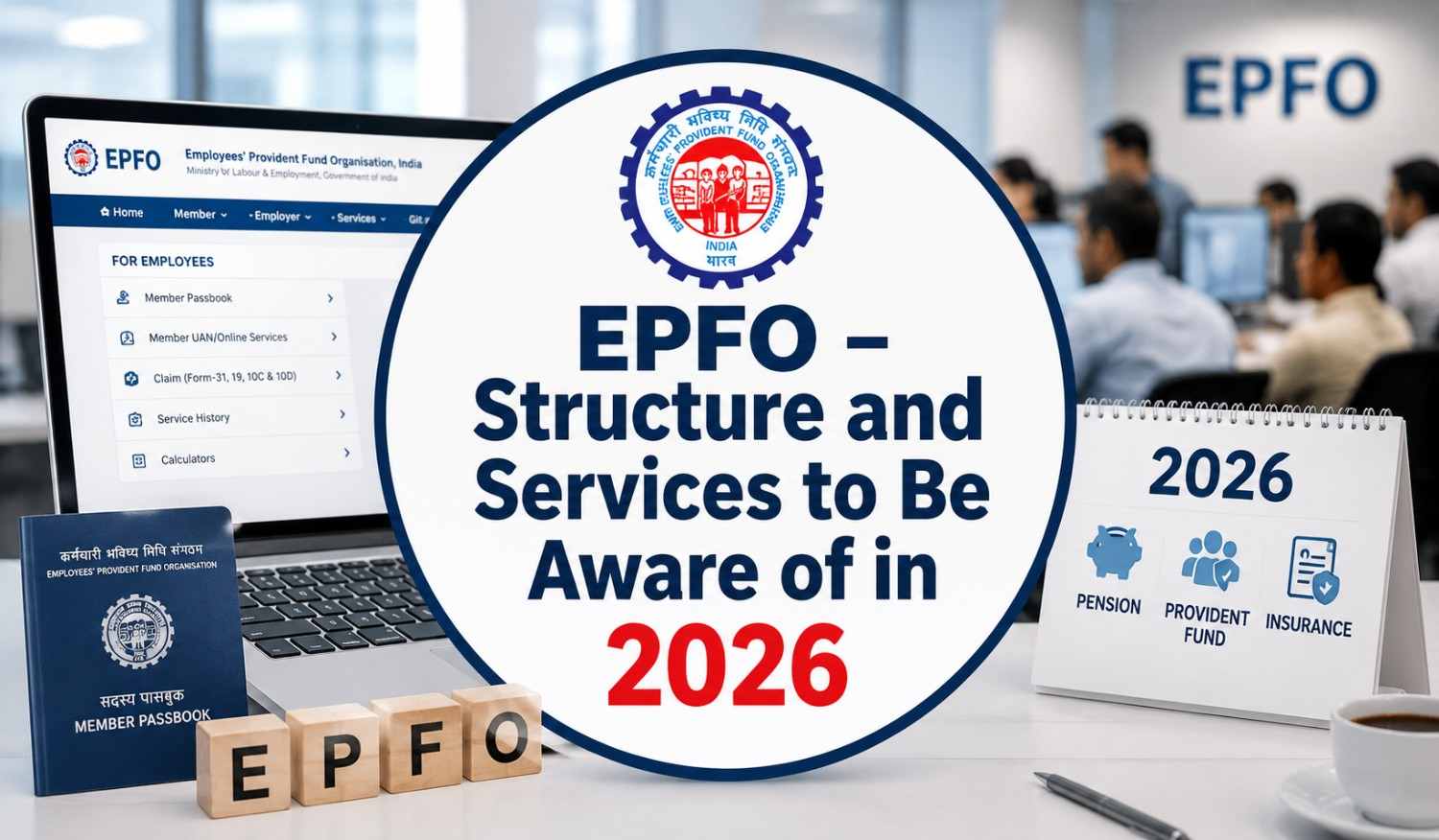
EPFO – Structure and Services to Be Aware of in 2026
The Employees’ Provident Fund Organisation (EPFO) is one of the statutory bodies set up by the Indian government, and it remains the country’s largest social security network. Its core job hasn’t changed since it was established in 1951 under the Ministry of Labour and Employment – nudge (and mandate) working India to save for retirement. What has changed a great deal is how EPFO delivers that mandate. Over the last two years the organisation has quietly rebuilt its entire backend, and 2026 is turning out to be the biggest year of reform in its history.
I’ve spent a fair bit of time on the EPFO portal and UMANG app myself while helping friends and colleagues sort out transfers and withdrawals, and the difference between the EPFO of 2022 and the EPFO of today is night and day – fewer physical visits, far fewer “your claim has been rejected, resubmit” emails, and a lot more happening through the phone. This piece walks through the structure, the core services, and what’s genuinely new this year.
EPF and Its Applicability
The Indian Constitution, under the Directive Principles of State Policy, requires the state to make effective provision for the right to work, education, and public assistance in cases of old age, unemployment, disablement, and sickness, within the limits of its economic capacity.
In line with this, the Employees’ Provident Fund came into existence through the EPF Ordinance of 1951, later replaced by the Employees’ Provident Funds Act, 1952, which was tabled in Parliament to provide provident fund cover to workers in factories and other establishments. The law governing EPF today is called the Employees’ Provident Funds and Miscellaneous Provisions Act, 1952, and it applies across the country.
The scheme is mandatory for establishments employing 20 or more people (some smaller establishments can register voluntarily), and – this is the big story of 2026 – the wage ceiling that decides who falls under it is finally set to move for the first time in over a decade.
EPFO Structure
The Act and its schemes are administered by a tripartite board – the Central Board of Trustees (CBT) – made up of representatives from the central government, state governments, employers, and employees, under the overall control of the Ministry of Labour and Employment. The CBT runs three core schemes:
- Employees’ Provident Fund Scheme, 1952 (EPF)
- Employees’ Pension Scheme, 1995 (EPS)
- Employees’ Deposit Linked Insurance Scheme, 1976 (EDLI)
EPFO itself is the executive arm that helps the CBT run these schemes day to day, under the administrative control of the Ministry of Labour and Employment.
Core Functions of EPFO
EPFO administers the provident fund, pension, and insurance schemes for every covered establishment and employee – including international workers – and is responsible for:
- Enforcing the EPF & MP Act across India
- Maintaining individual member accounts
- Settling claims (withdrawals, transfers, advances)
- Updating and correcting records
- Investing the fund’s corpus
- Ensuring timely pension disbursal
- Acting as the nodal agency for India’s bilateral Social Security Agreements with other countries
With more than 7 crore active contributing members and roughly 34 crore total accounts on its books, EPFO is among the largest social security organisations in the world by both beneficiary base and transaction volume.
What’s Changed: EPFO 3.0
If you’ve read about EPFO anywhere in the news this year, it’s almost certainly been about EPFO 3.0 – a full platform overhaul that’s rolled out through 2026 and is now largely live. It’s built on a new Centralised IT Enabled Services (CITES) system, replacing the old state-by-state, regional-office-by-regional-office database architecture with one unified national system. Practically, this means your claim is no longer tied to which regional office happens to hold your data – it can be viewed and processed from anywhere.
A few things worth knowing:
- UPI and ATM-based withdrawals. Members with a fully KYC-compliant UAN (Aadhaar, PAN, and bank account linked and digitally verified) can now withdraw eligible PF balances via UPI apps or a dedicated EPFO ATM card – no more waiting days for a bank transfer for smaller claims. A minimum of 25% of your balance is required to stay in the account at all times during active service, and there are caps on how much can move out via UPI/ATM in one go, so it isn’t a way to empty the account.
- Auto-settlement, without a human in the loop. EPFO has pushed hard on rule-based, automatic claim processing – the auto-settlement ceiling has moved up toward ₹5 lakh, and the organisation reports that around 95% of standard claims are now settled without manual intervention, up sharply from a couple of years ago. The system now does a pre-check of your claim before it even reaches an officer, flagging KYC mismatches upfront instead of rejecting the claim after the fact.
- No employer sign-off needed in most cases. If your UAN is Aadhaar-seeded and your bank account has been digitally verified (including by a previous employer), you generally don’t need your current employer’s approval to process a withdrawal – a genuinely big relief for anyone who has ever chased an ex-employer’s HR team for a signature.
My honest experience: the KYC step is still where most people get stuck. If your Aadhaar-linked mobile number doesn’t match what’s on your UAN, OTP-based authentication simply won’t go through, and that one mismatch causes more delays than anything else in the whole withdrawal process. Sorting KYC before you need to file a claim saves real time.
Interest Rate for FY 2025-26
The CBT has approved an EPF interest rate of 8.25% for FY 2025-26, the same rate as the previous two years, keeping EPF’s returns steady even as EPFO has flagged an actuarial deficit in the pension fund. Interest is calculated monthly on your running balance but credited once a year; if your account is inactive for 36 months it’s classified dormant and stops earning further interest. Credit for FY 2025-26 was targeted for completion by mid-July 2026 across roughly 34 crore accounts, worth over ₹1.44 lakh crore in aggregate.
The Wage Ceiling Is (Finally) Moving
The EPF wage ceiling – the salary limit up to which contributions are mandatory – has been stuck at ₹15,000/month since 2014. That’s over a decade of inflation with no revision, and it’s been the subject of a Supreme Court direction in early 2026 asking the government to resolve it within four months.
As of now, the Finance Ministry has cleared a proposal to raise the ceiling to ₹25,000/month, which would bring a large number of “excluded employees” (those earning between ₹15,001 and ₹25,000) into mandatory EPF and EPS coverage for the first time. Reports suggest the change won’t take effect immediately – a rollout around April 2027 is being discussed to give payroll systems time to adjust – so for now, if you’re checking your salary slip, the ₹15,000 ceiling (and the resulting ₹1,800 cap on the employee’s mandatory monthly contribution) still applies. Worth tracking if you’re in that income band, since it affects both your take-home pay and your long-term pension coverage.
There’s also an ongoing, unresolved conversation about raising the minimum EPS pension above its current ₹1,000/month – proposals of ₹5,000–₹7,500 have been floated for a few budget cycles running, but nothing has been formally notified yet.
Important Services Provided by EPFO
Universal Account Number (UAN)
UAN remains the backbone of everything EPFO does for individual members. It’s a 12-digit number that stays with you for life, linking every EPF account you’ve ever had across employers under one identity. The UAN programme itself dates back to October 2014 (part of the Pandit Deen Dayal Upadhyay Shramev Jayate Karyakaram), but its role has only grown – under EPFO 3.0, your UAN is now effectively your single login for balance checks, KYC updates, claims, and the new UPI/ATM withdrawal features.
Once activated on the UAN portal, you get access to:
- A dynamically updated EPF passbook
- A digital UAN card
- The ability to link previous member IDs to your current UAN
- SMS alerts when contributions are credited
- Auto-triggered transfer requests when you change jobs
UAN Member e-Sewa
The e-Sewa portal lets you register and activate your UAN, then use it to update KYC details, download your UAN card, view your passbook, and raise transfer requests – all self-service, without visiting a regional office.
Inoperative Accounts Helpdesk
Launched in 2015, this helpdesk makes it possible to trace old, dormant EPF accounts using basic details like previous employer and personal identifiers, and either settle them or transfer the balance into your current active account. If you’ve changed jobs a few times over the years and never got around to consolidating old PF accounts, this is the place to start – and it’s worth doing sooner rather than later, since dormant accounts stop earning interest after 36 months of inactivity.
Online EPF Transfer
The old standalone transfer-claim portal has long since been folded into the unified member portal under your UAN, making transfers between employers largely paperless.
Online Provident Fund Withdrawal
Members can withdraw their PF after 60 days of unemployment following resignation from prior employment (partial advances are available earlier for specific needs such as medical treatment, education, marriage, or home purchase). With Aadhaar-linked UANs and complete KYC, most of this process is now online end-to-end, and – as covered above – increasingly instant via UPI/ATM for eligible amounts.
Online Registration of Establishments (OLRE)
Employers can register new establishments with EPFO entirely online, with the PF code allotment letter issued digitally.
PF Payments Online
All establishments are required to remit EPF contributions online. EPFO has tie-ups with several major banks – including State Bank of India, Punjab National Bank, Bank of Baroda, Union Bank of India, ICICI Bank, HDFC Bank, Kotak Mahindra Bank, and Axis Bank – for collection of dues.
Certificate of Coverage for International Workers
A centralised online system lets EPF members working in countries with which India has a Social Security Agreement generate a Certificate of Coverage (COC), avoiding double social security contributions.
SMS and Missed Call Services
Members with an activated UAN can check their KYC status, latest EPF balance, and last contribution by sending an SMS in the format EPFOHO UAN <language-code> to 7738299899, or by giving a missed call from their registered mobile number to check their balance instantly.
Frequently Asked Questions
The rate for FY 2025-26 is 8.25% per annum, unchanged from the previous year. It’s calculated monthly on your running balance but credited to accounts once a year, typically completed a few months into the following financial year once the government formally approves the CBT’s recommendation.
The Finance Ministry has approved raising it from ₹15,000 to ₹25,000, following a Supreme Court direction to resolve the decade-long freeze. It hasn’t been formally notified into effect yet, and reports point to an effective date around April 2027 rather than an immediate change – so keep an eye on official EPFO notifications before assuming your contribution amount will change.
You need a fully KYC-compliant UAN – Aadhaar, PAN, and bank account linked and digitally verified, with your Aadhaar-registered mobile number matching your EPFO records for OTP authentication. Once that’s in place, eligible withdrawals can be requested via the UMANG app or a dedicated EPFO ATM card, with funds moving in minutes rather than the days or weeks the old process took. A portion of your balance (currently around 25%) must stay in the account during active service.
The most common cause by far is a KYC mismatch – an Aadhaar-linked mobile number that doesn’t match EPFO’s records, unverified bank details, or a UAN that hasn’t been Aadhaar-seeded. EPFO 3.0’s pre-validation system now flags these issues before your claim reaches an officer, so it’s worth checking your KYC status on the member portal proactively rather than waiting for a claim to bounce back.
Use the Inoperative Accounts Helpdesk on the EPFO portal, or simply check whether the old account is already linked under your UAN in the “previous member ID” section. If it’s separate, you can raise an online transfer request to consolidate it into your current active account – worth doing before the account crosses 36 months of inactivity, after which it stops earning interest.