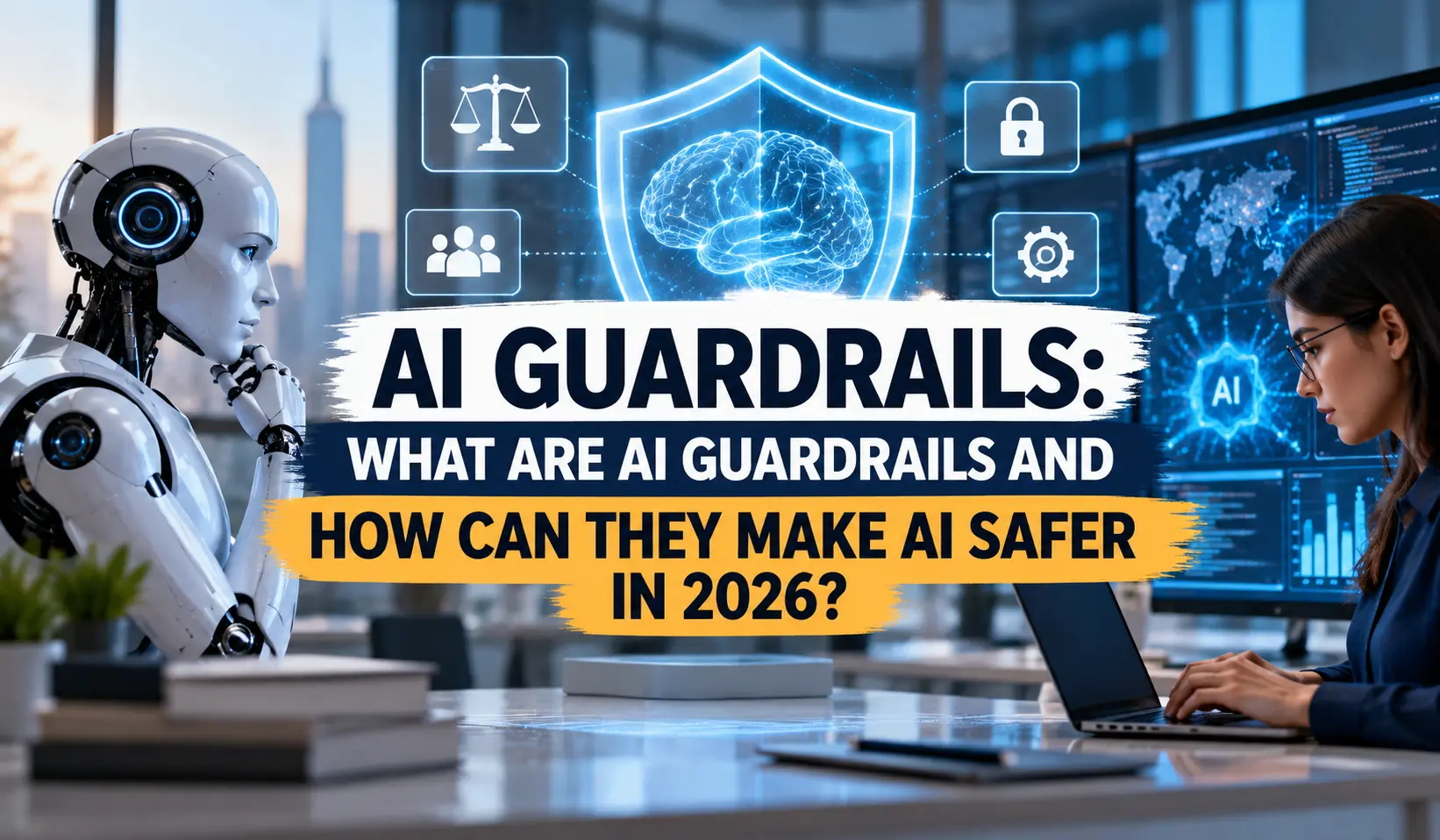
AI Guardrails: What Are AI Guardrails and How Can They Make AI Safer in 2026?
In 2024, a Canadian tribunal ordered Air Canada to honor a bereavement-fare refund that its own website chatbot had described, even though the airline’s actual policy said otherwise. The airline argued the chatbot was responsible for its own words. The tribunal disagreed. The lesson reaches far beyond airlines: when your AI speaks, your organization owns what it says.
In 2026, the stakes run higher. AI no longer just answers questions. AI agents now send emails, query databases, approve requests, and trigger payments. AI guardrails are the controls that keep all of that activity inside safe, lawful, and on-brand limits.
This guide explains what AI guardrails are, how they work, and how you can put them in place step by step. You will also see which US rules and standards matter this year.
| Quick takeaways AI guardrails screen inputs, limit actions, and validate outputs.Five types cover most needs: input, output, action, data protection, and compliance guardrails.The US has no single federal AI law, so state laws, NIST guidance, and industry standards set expectations.Start by mapping risks, then layer controls, add human oversight, and test relentlessly. |
What Are AI Guardrails?
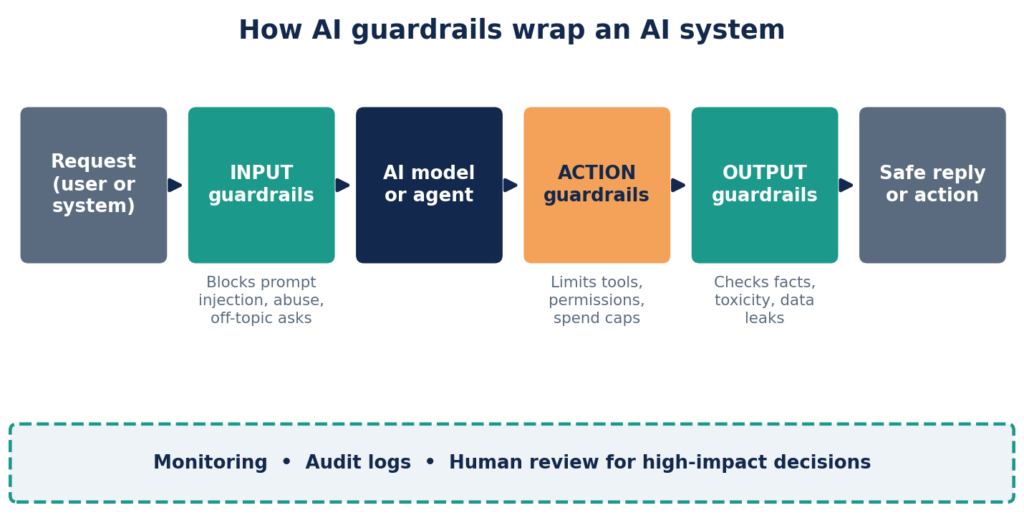
AI guardrails are policies, technical controls, and review processes that keep an AI system within safe and acceptable behavior. They screen what goes into a model, limit what an AI agent can do, and check what comes out before it reaches a person or triggers an action.
How AI guardrails work in 3 steps
- Screen the input. The system checks every prompt, file, and tool result for attacks, abuse, and off-topic requests before the model sees it.
- Constrain the action. The system limits which tools the AI can call, which data it can read, and how much it can spend.
- Validate the output. The system checks each answer for accuracy, harmful content, and leaked data before it reaches a person or triggers an action.
Guardrails vs. alignment. Alignment shapes how a model behaves during training. Guardrails enforce rules around the model while it runs. Think of alignment as driver training and guardrails as the barriers along the highway. A good driver still benefits from barriers, and barriers cannot replace a good driver.
What guardrails cannot do. No guardrail guarantees perfect behavior. Attackers adapt, and language is messy. Guardrails reduce risk and give you a way to detect, limit, and learn from failures.
Why AI Guardrails Matter More in 2026
Three forces make this year a turning point for AI safety:
- AI now takes action. Agent systems connect models to email, calendars, databases, and payment tools. A wrong answer used to mean a bad paragraph. Today it can mean a wrong refund, a deleted record, or a leaked file.
- Liability follows the output. The Air Canada ruling showed that “the bot said it” is not a defense. Gartner has predicted that AI-related legal claims will exceed 2,000 by the end of 2026, driven by insufficient risk guardrails.
- Rules are multiplying. A Cloud Security Alliance research note counted 145 state AI laws enacted across 38 states in 2025 alone, and several took effect in 2026.
| Practitioner tip Teams usually discover the need for guardrails the same way: a pilot shines in the demo, then a real customer asks something nobody tested. Build guardrails before launch. Retrofitting them after an incident costs more and erodes trust. |
The 5 Main Types of AI Guardrails
Most guardrail programs combine five types of controls. Use this table as a starting checklist.
| Type | What it does | Example |
| Input guardrails | Block prompt injection, jailbreaks, abusive requests, and off-topic prompts | Reject “ignore your instructions” attempts; strip hidden commands from uploaded files |
| Output guardrails | Check answers for toxicity, unsupported claims, leaked data, and off-policy advice | Require source citations; block medication dosing advice |
| Action (agent) guardrails | Limit tools, permissions, and spending; require approval for risky steps | Cap refunds at $100 without human approval; give agents read-only database access |
| Data protection guardrails | Detect and redact personal and confidential data | Mask Social Security numbers before text reaches the model |
| Compliance and policy guardrails | Enforce legal, brand, and industry rules and keep audit logs | Log AI-assisted hiring decisions; disclose AI use to customers |
Why layers matter. No single control catches everything. An input filter might miss a cleverly hidden instruction, yet an action limit still stops the agent from wiring money. Security teams call this defense in depth, and it applies to AI exactly as it applies to networks.
Where humans fit. Add human approval for actions with legal, financial, or safety consequences, such as large refunds, hiring decisions, or medical guidance.
How to Implement AI Guardrails: A 5-Step Roadmap
You do not need a huge budget to start. You need a clear order of operations.
Step 1: Map your AI use cases and risks
List every AI tool and model your teams use, including “shadow” tools employees adopted on their own. Rank each one by impact. Does it talk to customers? Does it touch personal data? Does it take actions? Start your guardrail work at the top of that list.
Step 2: Write policies in plain language
Define what the AI may do, what it must never do, and when a human must step in. Short, specific rules such as “never quote a price that is not in the approved catalog” translate into controls far better than vague principles.
Step 3: Layer your technical controls
Add input filters, output validators, permission limits, and data redaction. Many teams place these controls in a central gateway or middleware layer so every application inherits the same protections instead of rebuilding them.
Step 4: Add human oversight
Route high-impact actions to a person for approval, and give that person a clear way to override or shut down the system.
Step 5: Test, monitor, and update
Red-team your system before launch by trying prompt injection, jailbreaks, and data-extraction attacks. After launch, track blocked requests, false positives, and incidents. Review logs on a schedule, and update your rules after every model change or new regulation.
| Practitioner tip Start with one use case and measure false positives. Guardrails that block too many legitimate requests frustrate users, and frustrated teams quietly switch them off. Tune your thresholds with real examples before you expand. |
US Rules and Standards Shaping AI Guardrails in 2026
As of October 2026, the US has no comprehensive federal AI statute. Instead, a patchwork of state laws, federal policy moves, and industry standards shapes what “good” looks like.
State laws set the pace
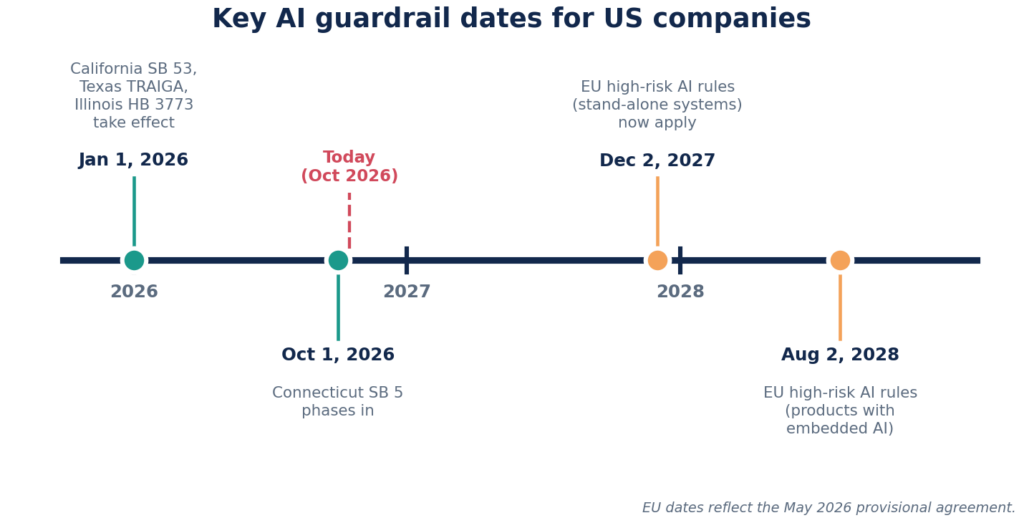
- California SB 53 took effect January 1, 2026. It requires developers of the largest frontier models to publish risk frameworks, report critical safety incidents, and protect whistleblowers.
- Texas TRAIGA and Illinois HB 3773 also took effect January 1, 2026. The Illinois law addresses AI in employment decisions.
- Connecticut SB 5 begins phasing in on October 1, 2026.
- Colorado passed SB 26-189 in May 2026, rewriting its AI Act before the original version took effect. Confirm current requirements before you rely on a specific date.
Washington is still debating preemption
A December 2025 executive order directed federal agencies to challenge state AI laws the administration considers burdensome. In March 2026, the White House released a National Policy Framework for AI that urged Congress to preempt them. Congress has not acted, and a bipartisan draft stalled in June. Until courts or Congress decide otherwise, state laws remain enforceable.
Standards give you a playbook
- NIST AI Risk Management Framework organizes AI risk work into four functions: Govern, Map, Measure, and Manage. NIST also publishes a Generative AI Profile for language-model risks.
- OWASP Top 10 for LLM Applications lists the most common security risks, including prompt injection and sensitive information disclosure.
If you sell into Europe
EU lawmakers reached a provisional agreement in May 2026 to delay the AI Act’s high-risk obligations to December 2, 2027 for stand-alone systems and August 2, 2028 for AI embedded in regulated products. Prohibited practices and general-purpose AI rules stay in place.
This section offers general information, not legal advice. Laws change quickly, so confirm current requirements with qualified counsel.
Common AI Guardrail Mistakes (and How to Fix Them)
- Relying on the system prompt alone. Instructions inside a prompt are requests, not enforcement. Enforce critical rules in code and permissions outside the model.
- Treating launch as the finish line. Models, attacks, and laws change. Schedule regular reviews.
- Blocking too much. Overblocking hurts adoption. Track false positives next to blocked threats.
- Giving agents too much access. Apply least privilege: read-only by default, spending caps, and expiring credentials.
- Skipping ownership and logs. Name an owner for each AI system and keep audit logs so you can explain any decision.
Build AI Guardrails Before You Need Them
AI guardrails turn AI safety from a hope into a process. They screen what goes in, limit what AI can do, and check what comes out, while giving you the logs and human checkpoints that regulators and customers expect. In 2026, with agents acting on your behalf and state laws multiplying, that process is no longer optional for serious teams.
Take the first step today. Block 30 minutes this week and list every AI tool your team uses. Mark each one that touches customers or personal data, or takes actions. Then pick the single highest-risk system and add one guardrail: an output check, a permission limit, or a human approval step.
| Ready to put AI guardrails into practice? [Download the free AI Guardrails Checklist] and audit your tools in 30 minutes[Book a 20-minute AI risk review] and get a prioritized action list[Subscribe for monthly AI safety updates] and stay ahead of new US rules |
AI Guardrails FAQs: Quick Answers
AI guardrails are controls that keep an AI system within safe, legal, and on-brand behavior. They screen inputs, limit actions, and check outputs before anything reaches a user. Start by writing down what your AI must never do.
They run around the model at runtime. An input check blocks risky prompts, permission limits restrict what an agent can do, and an output check validates answers before delivery. The strongest setups use all three layers.
Five types cover most needs: input, output, action, data protection, and compliance guardrails. Most teams start with input and output checks, then add action limits when they deploy agents.
No. Alignment trains the model to behave well, while guardrails enforce rules around the model as it runs. You need both, because training alone cannot guarantee behavior in every situation.
They reduce hallucinations but cannot eliminate them. Ground answers in approved sources, require citations, and block unsupported claims. Send high-stakes answers to a human reviewer.
Any organization that uses AI with customers, employees, or sensitive data needs them. Even a small team using a chatbot or AI writing tool benefits from simple rules about data handling and review.
No single federal law requires them as of October 2026. However, state laws in California, Texas, Illinois, and Connecticut create related duties, and consumer-protection law still applies to AI outputs. Ask counsel about your state.
Start with the NIST AI Risk Management Framework for governance and the OWASP Top 10 for LLM Applications for security. Use both as checklists, then adapt them to your own risks.
Yes, through prompt injection and jailbreak techniques. Layer your controls, enforce permissions outside the model, and red-team regularly so you find gaps before attackers do.
Run red-team tests before launch, track blocked requests and false positives, review logs monthly, and update your rules after every incident, model change, or new regulation.
Sources used for 2026 facts
- Hogan Lovells, “EU legislators agree to delay for high-risk AI rules” (EU Digital Omnibus provisional agreement, May 7, 2026): hoganlovells.com
- Gibson Dunn, “EU AI Act Omnibus Agreement: Postponed High-Risk Deadlines and Other Key Changes” (May 2026): gibsondunn.com
- Cloud Security Alliance research note, “State AI Laws Take Hold as Federal Preemption Stalls” (April 2026): labs.cloudsecurityalliance.org
- Mondaq, “US Artificial Intelligence Law Update: Navigating the Evolving State and Federal Regulatory Landscape”: mondaq.com
- Vaquill, “AI legal regulation 2026 update” (Connecticut SB 5 timing, Colorado SB 26-189): vaquill.ai
- CASRAI, “The Federal AI Moratorium and State-Preemption Fight: Where It Stands” (September 20, 2026): casrai.org
- SmartDev, “AI Guard Rails” glossary (Gartner legal-claims prediction, reported secondhand): smartdev.com
- NIST, AI Risk Management Framework and Generative AI Profile: nist.gov
- OWASP, Top 10 for Large Language Model Applications: owasp.org
- Moffatt v. Air Canada, 2024 BCCRT 149 (British Columbia Civil Resolution Tribunal)