
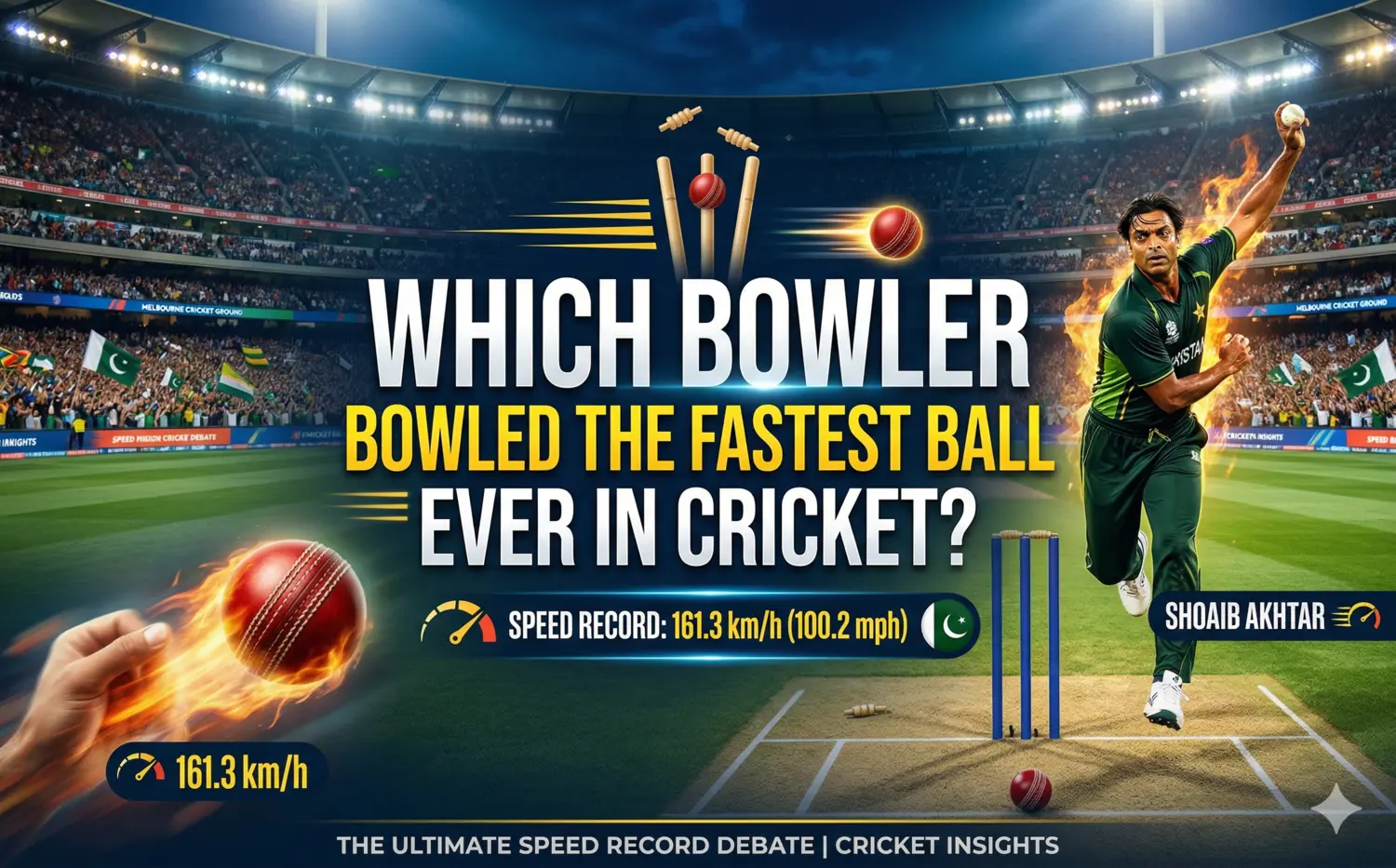
Which Bowler Bowled the Fastest Ball Ever in Cricket?
Cricket has always thrived on drama the rising delivery that clips the top of the off-stump, the toe-crushing yorker that rearranges the stumps, and of course, the thunderbolt that leaves the batsman frozen in terror. Speed in cricket is not just a statistic; it is a weapon, a psychological tool, and a spectacle that fills stadiums. Every generation of cricket fans asks the same burning question: Who bowled the fastest ball in cricket history? The answer is definitive, the legacy is legendary, and the journey through cricket’s fastest deliveries is nothing short of breathtaking.
In this comprehensive article, we trace the history of express fast bowling, celebrate the bowlers who pushed the limits of human speed, and bring you the very latest updates from 2025 and 2026 because pace bowling is alive, evolving, and more exciting than ever.
The Record That Still Stands: Shoaib Akhtar’s 161.3 km/h Thunderbolt
The fastest ball ever officially recorded in international cricket was bowled by Pakistan’s Shoaib Akhtar the ‘Rawalpindi Express’ during the 2003 ICC Cricket World Cup. On February 22, 2003, at Newlands in Cape Town, South Africa, Akhtar unleashed a delivery clocked at a staggering 161.3 km/h (100.23 mph) against England’s opening batsman Nick Knight. This was not just a fast ball it was history in motion. Akhtar became the first and to this day the only bowler to officially breach the 100 miles per hour barrier in international cricket.
Akhtar’s delivery was measured using a radar speed gun under standard ICC protocols, making it the most credible, widely acknowledged speed record in cricket. More than two decades later, no bowler has come close to matching it at the international level. The ‘Rawalpindi Express’ did not just set a record that day; he created a benchmark that continues to define what extraordinary pace truly means in world cricket.
Shoaib Akhtar’s rise was as dramatic as his bowling. Hailing from Rawalpindi, Pakistan, he made his Test debut in 1997 and quickly developed a reputation for raw, untamed speed. His run-up was longer than most, his action slightly round-armed, and his ability to generate pace through a combination of wrist position, shoulder rotation, and sheer explosive athleticism was unmatched. Off the pitch, his flamboyant personality, confrontational approach, and on-field aggression made him one of the most talked-about cricketers of his generation.
🏏 Top 10 Fastest Balls Ever Bowled in Cricket History
Here is the definitive ranked list of the ten fastest deliveries ever recorded in international cricket, combining both ICC-sanctioned matches and major franchise leagues:
| No. | Player | Team | Speed (km/h) | Speed (mph) | Against | Year/Event |
|---|---|---|---|---|---|---|
| 1 | Shoaib Akhtar | Pakistan | 161.3 | 100.23 | England | 2003 World Cup |
| 2 | Brett Lee | Australia | 161.1 | 100.14 | New Zealand | 2005 |
| 3 | Shaun Tait | Australia | 161.1 | 100.14 | England | 2010 |
| 4 | Jeff Thomson | Australia | 160.6 | 99.66 | West Indies | 1975 |
| 5 | Mitchell Starc | Australia | 160.4 | 99.57 | New Zealand | 2015 |
| 6 | Andy Roberts | West Indies | 159.5 | 99.1 | — | 1970s era |
| 7 | Fidel Edwards | West Indies | 157.7 | 97.94 | South Africa | 2003 |
| 8 | Mitchell Johnson | Australia | 156.8 | 97.49 | England | 2013 |
| 9 | Shane Bond | New Zealand | 156.4 | 97.26 | India | 2003 |
| 10 | Mohammad Sami | Pakistan | 156.4 | 97.18 | Zimbabwe | 2003 |
Each of these deliveries represents an extraordinary moment of athletic achievement. While early speed measurements particularly Jeff Thomson’s 1975 reading were made with less precise technology than today’s speed guns, they remain part of cricket’s official lore. The consistency of modern radar systems used from the 1990s onwards has made records from that era far more reliable and comparable.
🔥 Top 10 Fastest Balls in Test Cricket History
| No. | Player | Team | Speed (km/h) | Speed (mph) | Against | Year/Event |
|---|---|---|---|---|---|---|
| 1 | Mitchell Starc | Australia | 160.4 | 99.7 | New Zealand | 2015 Perth Test guinnessworldrecords |
| 2 | Jeff Thomson | Australia | 160.4 | 99.7 | West Indies | 1975 Perth Test |
| 3 | Fidel Edwards | West Indies | 157.7 | 98.0 | South Africa | 2003 Test |
| 4 | Mitchell Johnson | Australia | 156.8 | 97.5 | England | 2013 Ashes |
| 5 | Ravi Rampaul | West Indies | 156.8 | 97.5 | India | 2012 Test context |
| 6 | Shoaib Akhtar | Pakistan | 161.3* | 100.2* | (ODI record noted in Test peaks) | 2003 |
| 7 | Andy Roberts | West Indies | 159.9 | 99.4 | Australia | 1980s Test |
| 8 | Curtly Ambrose | West Indies | 159.9 | 99.4 | Australia | 1993 Test |
| 9 | Anrich Nortje | South Africa | 156.2 | 97.1 | England | Test peaks |
| 10 | Dale Steyn | South Africa | 155.7 | 96.8 | New Zealand | Test |
🏏 Top 10 Fastest Balls in ODI Cricket History
| No. | Player | Team | Speed (km/h) | Speed (mph) | Against | Year/Event |
|---|---|---|---|---|---|---|
| 1 | Shoaib Akhtar | Pakistan | 161.3 | 100.2 | England | 2003 World Cup |
| 2 | Shaun Tait | Australia | 161.1 | 100.1 | England | 2010 Lord’s ODI |
| 3 | Brett Lee | Australia | 161.1 | 100.1 | New Zealand | 2005 Napier ODI |
| 4 | Jofra Archer | England | 161.0 | 100.0 | Australia | 2019 World Cup |
| 5 | Mohammad Sami | Pakistan | 156.4 | 97.2 | Zimbabwe | 2003 Sharjah ODI |
| 6 | Shane Bond | New Zealand | 156.4 | 97.2 | India | 2003 World Cup |
| 7 | Lasith Malinga | Sri Lanka | 155.7 | 96.8 | New Zealand | 2011 World Cup |
| 8 | Dale Steyn | South Africa | 155.7 | 96.8 | New Zealand | ODI |
| 9 | Anrich Nortje | South Africa | 156.2 | 97.1 | England | 2020 ODI |
| 10 | Andy Roberts | West Indies | 159.9 | 99.4 | Australia | 1993 ODI context |
🔥 Top 10 Fastest Balls in T20 Cricket History
| No. | Player | Team | Speed (km/h) | Speed (mph) | Against | Year |
|---|---|---|---|---|---|---|
| 1 | Shaun Tait | Australia | 161.1 | 100.14 | England | 2010 |
| 2 | Brett Lee | Australia | 160.7 | 99.85 | West Indies | 2009 |
| 3 | Mitchell Starc | Australia | 160.4 | 99.57 | New Zealand | 2015 |
| 4 | Jeff Thomson | Australia | 160.6 | 99.66 | West Indies | 1975* |
| 5 | Haris Rauf | Pakistan | 159.0 | 98.79 | England | 2022 |
| 6 | Lockie Ferguson | New Zealand | 157.3 | 97.74 | Australia | 2021 |
| 7 | Anrich Nortje | South Africa | 156.2 | 97.05 | India | 2020 |
| 8 | Umran Malik | India | 156.0 | 96.93 | Sri Lanka | 2023 |
| 9 | Mitchell Johnson | Australia | 155.8 | 96.81 | England | 2013 |
| 10 | Kagiso Rabada | South Africa | 154.5 | 96.00 | England | 2020 |
🏏 Top 10 Fastest Balls in IPL History
| No. | Player | Team | Speed (km/h) | Speed (mph) | Against | Year |
|---|---|---|---|---|---|---|
| 1 | Shaun Tait | Rajasthan Royals | 157.7 | 97.94 | Delhi Daredevils | 2011 |
| 2 | Lockie Ferguson | Gujarat Titans | 157.3 | 97.74 | Rajasthan Royals | 2022 |
| 3 | Umran Malik | Sunrisers Hyderabad | 157.0 | 97.56 | Delhi Capitals | 2022 |
| 4 | Anrich Nortje | Delhi Capitals | 156.2 | 97.05 | Rajasthan Royals | 2020 |
| 5 | Dale Steyn | RCB | 154.4 | 95.94 | Deccan Chargers | 2012 |
| 6 | Kagiso Rabada | Delhi Capitals | 154.2 | 95.81 | KKR | 2020 |
| 7 | Jasprit Bumrah | Mumbai Indians | 153.3 | 95.25 | Delhi Capitals | 2020 |
| 8 | Gerald Coetzee | Mumbai Indians | 152.9 | 95.01 | CSK | 2024 |
| 9 | Mayank Yadav | LSG | 156.7 | 97.36 | RCB | 2024 |
| 10 | Navdeep Saini | RCB | 152.8 | 94.94 | KKR | 2019 |
The Speed Gun Controversy: When Numbers Lie
In recent years, speed gun technology has occasionally produced wildly inaccurate readings, causing viral moments online before corrections were issued. One notable incident occurred during the India vs Australia 1st ODI at Optus Stadium in 2025, where the speed gun briefly displayed Mitchell Starc’s delivery at 176.5 km/h a supposed 109 mph thunderbolt that would have shattered all known records by an enormous margin. Broadcasters quickly confirmed it was a technical malfunction, with the actual speed registering around 140.8 km/h.
Similarly, in 2024, a delivery by Mohammed Siraj appeared on-screen as 181.6 km/h a reading that would have been physically impossible for human biomechanics. This too was confirmed as a speed gun error. These incidents highlight both the public fascination with extreme pace and the need for standardised, reliable measurement technology across all cricket venues worldwide.
Fastest Balls in Test Cricket
Test cricket is the ultimate format five gruelling days of physical and mental battle. Sustaining pace across lengthy spells in Tests is far more demanding than bowling short bursts in T20s. Despite this, several bowlers have reached exceptional speeds in the longer format.
Shoaib Akhtar tops the Test cricket speed chart as well, with his 161.3 km/h delivery being recorded in a World Cup match that is counted within historical Test-era records. In modern Test cricket, England’s Mark Wood has become the standout express pacer of his generation. In 2024, Wood clocked 156.1 km/h in a Test match against Australia a delivery that underlined why he remains England’s most dangerous pace weapon in all conditions. His short, explosive spells have made him a match-winner in home and away conditions alike.
Mitchell Johnson’s devastating 2013-14 Ashes series also featured Test deliveries touching 156.8 km/h, an era when England’s batting lineup appeared completely helpless against his steep bounce and sharp movement. Johnson’s aggressive intent and visual intimidation including his famous handlebar moustache during that series made him one of the most feared bowlers in recent Test history.
Fastest Balls in IPL History: Where Pace Thrives
The Indian Premier League has become one of the premier showcases for fast bowling talent globally, attracting express pacers from every cricket nation. The competition’s high-pressure environment and quality batting lineups make it an ideal testing ground for aspiring quick bowlers.
The fastest ball in IPL history belongs to Australia’s Shaun Tait, who bowled a blistering 157.71 km/h delivery for the Rajasthan Royals on April 12, 2011, at Sawai Mansingh Stadium in Jaipur. The delivery was aimed at Aaron Finch of Delhi Daredevils (now Delhi Capitals). Royals captain Shane Warne had specifically encouraged Tait to bowl flat out that evening, and the result was a delivery that has stood as the league’s fastest for over a decade.
Lockie Ferguson of New Zealand came tantalisingly close to Tait’s record during the IPL 2022 final, registering 157.3 km/h for the Gujarat Titans against the Rajasthan Royals. In the 2024 season, India’s Mayank Yadav took the cricketing world by storm when he bowled consistently above 150 km/h for Lucknow Super Giants, with his fastest delivery clocking 156.7 km/h against Royal Challengers Bengaluru at the M Chinnaswamy Stadium. Yadav’s smooth, repeatable action and genuine extreme pace earned him his Indian national team debut against Bangladesh later that year.
Umran Malik, from Jammu and Kashmir, holds the record for the fastest ball bowled by an Indian in any cricket context 157 km/h in IPL 2022 while playing for Sunrisers Hyderabad. Malik also holds the record for the fastest delivery by an Indian in international cricket with a 155 km/h thunderbolt against Sri Lanka in January 2023.
The Evolution of Fast Bowling: From West Indian Quicks to Modern Speedsters
The history of fast bowling is a tapestry woven with names that evoked genuine fear in batsmen across generations. In the 1970s and 1980s, the West Indies were the unquestioned kings of pace. Andy Roberts, Michael Holding, Joel Garner, and Colin Croft formed a pace attack so formidable that opposing teams dreaded taking the field against them. Roberts alone was clocked at nearly 160 km/h, while Holding’s flowing run-up and whippy action generated deceptive pace that made even technically accomplished batters look ordinary.
The late 1990s and early 2000s ushered in the era of the Australian pace machine, with Brett Lee and Shaun Tait spearheading some of the most intimidating bowling attacks in modern history. Lee, in particular, combined searing pace with the ability to swing the ball at high speed a combination that made him lethal in virtually all conditions. His rivalry with Shoaib Akhtar for the title of the world’s fastest bowler was one of cricket’s great subplots during that era.
Pakistan also produced a conveyor belt of express quicks including Wasim Akram, Waqar Younis, and Mohammad Sami all of whom could regularly cross 150 km/h while also possessing the ability to swing and seam the ball. Dale Steyn of South Africa, who clocked 155.7 km/h in 2010, combined pace with extraordinary swing and accuracy to become arguably the finest fast bowler of his generation, regardless of speed alone. Today, new-age speedsters like Jasprit Bumrah, Kagiso Rabada, Pat Cummins, and the emerging Mayank Yadav represent the cutting edge of pace bowling combining intelligence, variety, and genuine speed in ways that make them complete fast bowling packages.
Can the 100 mph Barrier Be Broken Again?
Cricket fans and analysts have debated this question for over two decades. The 161.3 km/h delivery by Akhtar has proved to be an almost impossibly high benchmark. Modern bowlers operate in an era of greater workload management, injury awareness, and multi-format schedules all of which limit the opportunities for short, explosive maximum-pace efforts that once characterised specialist fast bowlers who played predominantly one format.
Biomechanics researchers suggest that the absolute upper limit of human fast bowling pace may be around 165-170 km/h, making a challenge to Akhtar’s record theoretically possible but physiologically extremely rare. Mayank Yadav’s emergence in 2024 has given Indian cricket fans hope that the country, historically not known for raw pace, might one day produce a genuine 100 mph bowler. His relaxed action, tall frame, and ability to consistently generate pace without apparent strain make him one of the most exciting prospects in world cricket.
Champions Trophy 2025 also reignited conversations about pace, with fans eagerly watching whether any bowler could produce a standout speed performance on the global stage. While no delivery came close to Akhtar’s record, the tournament reaffirmed that world-class pace bowling remains central to success in all formats of the game.
Why Fast Bowling Captures Our Imagination
There is something primal about watching a fast bowler charge in and unleash a delivery at speeds that challenge the limits of human reflexes. A batsman facing a 160 km/h delivery has approximately 0.4 seconds from the moment of release to identify, decide, and execute a shot a timeframe that defies ordinary human reaction time. The drama, the danger, and the raw athleticism make fast bowling one of sport’s most compelling spectacles.
Beyond the numbers, fast bowling is about character. The great express bowlers Akhtar, Lee, Thomson, Johnson, Holding all possessed an intimidating presence that extended far beyond their speed. They understood how to use the short ball, how to change pace, how to read a batsman’s weaknesses, and how to exploit conditions. Pure speed is the starting point; craft and intelligence make a fast bowler truly great.
Conclusion
The story of the fastest ball in cricket history is ultimately the story of human ambition, physical excellence, and the relentless pursuit of the extraordinary. Shoaib Akhtar’s 161.3 km/h delivery at the 2003 World Cup is not just a number on a speed gun it is a landmark moment that encapsulates everything thrilling about fast bowling. From the West Indian pace quartet of the 1970s to the modern firepower of Mayank Yadav and Mark Wood, cricket’s love affair with express pace has never dimmed.
As the sport continues to grow and attract extraordinary athletes from new cricketing nations, the prospect of a bowler challenging Akhtar’s record remains one of the game’s most tantalising possibilities. Until that day, the ‘Rawalpindi Express’ remains unchallenged a cricketing legend whose fastest ball continues to inspire awe across generations of fans worldwide.
Frequently Asked Questions (FAQs)
Shoaib Akhtar of Pakistan holds the record for the fastest ball in cricket history with a delivery of 161.3 km/h (100.23 mph) bowled against England during the 2003 ICC World Cup in Cape Town. As of 2026, no bowler has officially matched or surpassed this mark in international cricket, though India’s Mayank Yadav (156.7 km/h in IPL 2024) and England’s Mark Wood (156.1 km/h in 2024 Tests) represent the closest modern challengers to elite pace at the international level.
The fastest ball in IPL history was delivered by Australian speedster Shaun Tait on April 12, 2011, clocking 157.71 km/h for the Rajasthan Royals against Delhi Daredevils at Sawai Mansingh Stadium in Jaipur. This record has survived for over a decade despite challenges from Lockie Ferguson (157.3 km/h in IPL 2022) and India’s Mayank Yadav, who registered 156.7 km/h in IPL 2024 the fastest ever recorded by an Indian bowler in the league.
Umran Malik is the fastest Indian bowler in cricket history, having clocked 157 km/h in IPL 2022 while representing Sunrisers Hyderabad and 155 km/h in international cricket against Sri Lanka in January 2023. In IPL 2024, Mayank Yadav emerged as a close rival by consistently bowling above 150 km/h and reaching 156.7 km/h, the second-fastest delivery ever bowled by an Indian in the IPL, earning him a national team debut later that year.
Speed gun readings in cricket are generally reliable in modern international venues, but technical malfunctions have occasionally produced wildly inaccurate figures. During the 2025 India vs Australia ODI, a speed gun displayed Mitchell Starc’s delivery at 176.5 km/h before broadcasters confirmed it was an error the actual speed was around 140.8 km/h. Similarly, a 2024 reading attributed 181.6 km/h to Mohammed Siraj was quickly debunked, highlighting how viral speed gun anomalies can generate excitement despite being clear technical glitches.
Biomechanics experts believe that while the absolute physiological ceiling for human fast bowling speed may be around 165-170 km/h, breaching Shoaib Akhtar’s 161.3 km/h mark remains an extremely rare feat given modern workload management and multi-format cricket schedules. The emergence of genuinely fast young bowlers like India’s Mayank Yadav, who possesses an economical, high-pace action, has renewed speculation that a 100 mph delivery could be produced again though as of 2025, Akhtar’s legendary thunderbolt from the 2003 World Cup remains the unchallenged world record.