Quick Highlights
- Define your industrial process before selecting a PLC panel.
- Choose compact or modular PLCs according to control requirements.
- Check I/O capacity, electrical ratings, and communication compatibility.
- Select enclosure protection according to actual factory conditions.
- Review wiring quality, documentation, testing, and safety needs.
- Compare manufacturers based on technical support and component quality.
- Plan future expansion and maintenance before approving the final design.
Are you planning to automate your factory and wondering how to choose the right PLC panel for your industrial application in India? The correct panel can help you control machines, manage production tasks, and reduce manual work.
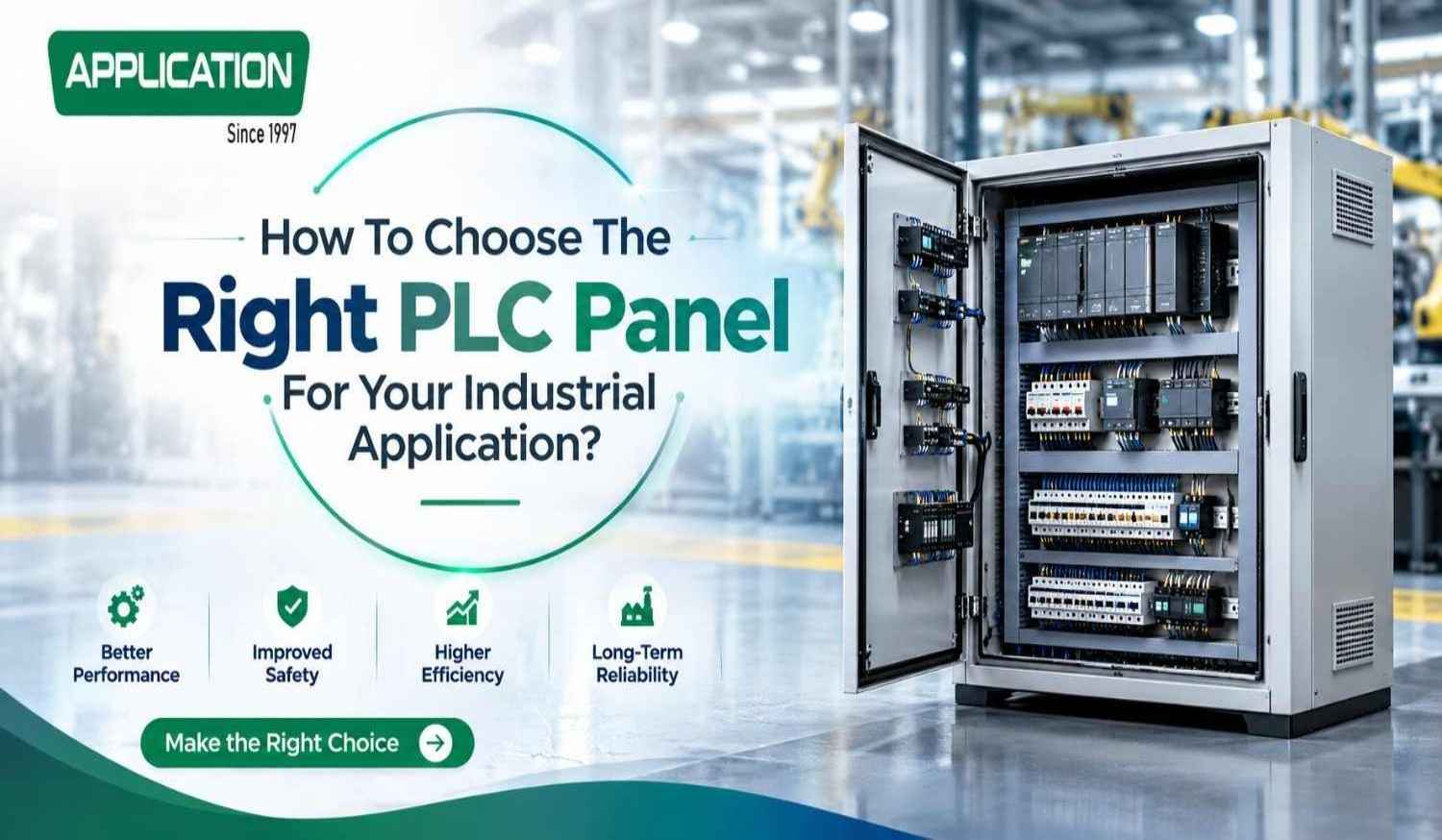
A PLC panel is an electrical control panel that uses a Programmable Logic Controller (PLC) to control machines and industrial processes. It receives signals from sensors, processes them, and sends commands to equipment such as motors, pumps, and conveyor belts.
Let us discuss the main factors you should check before buying a PLC control panel in this article written by one of the best PLC panel manufacturers –
Why Does Your Industry Need a PLC Panel?
Industries use these for tasks that need accurate control and regular operation.
These panels can offer several benefits:
- It controls machines through programmed instructions.
- It reduces the need for manual operation.
- It helps maintain consistent production steps.
- It allows operators to monitor machine conditions.
- It can support fault detection and troubleshooting.
- It can connect with other industrial control systems.
How Should You Choose a PLC Panel for Your Industrial Application?
You should start by understanding your machines and the tasks you want to automate. This step helps you select the right PLC, input and output capacity, panel size, and control features.
Before contacting manufacturer, answer these questions about your application.
- Which machines or processes do you want to control?
- How many sensors and switches will the system use?
- How many motors, valves, and other devices need control?
- Does the process need continuous operation?
- Do you need automatic control, manual control, or both?
- Will operators monitor the system from a control screen?
Which PLC Type Is Best for Your Industrial Requirements?
The best PLC type depends on the number of devices, control tasks, and communication needs. Small applications may work well with a compact PLC.
Compact PLC
It combines the main control functions in one unit. It suits small machines and simple automation tasks.
You can consider this type for small packaging machines, water pumps, basic conveyor systems, and standalone equipment.
Modular PLC
It uses separate modules for different functions. You can add modules for digital inputs, digital outputs, analogue signals, or communication.
This type suits larger machines and production lines that need more control points. It can also help when your system may need extra functions later.
PLC with HMI Support
An HMI, or Human Machine Interface, gives operators a screen to view machine status and enter commands.
A PLC with HMI support suits applications where operators need regular access to machine information.
What Technical Specifications Should You Check Before Buying a PLC Panel?
You should check the electrical ratings, I/O capacity, communication options, panel protection, and control requirements before placing an order.
Input and Output Capacity
Inputs receive signals from devices such as sensors, push buttons, and limit switches. Outputs send commands to devices such as contactors, indicator lamps, and valves.
Power Supply and Electrical Ratings
Check the available supply voltage and the electrical ratings of connected equipment. The PLC, power supply, contactors, relays, and other components must suit the application.
Communication and Monitoring
Some PLC panels need to communicate with drives, HMIs, sensors, or supervisory control systems. Confirm that the selected PLC supports the protocols your equipment requires.
Panel Enclosure and Protection
The panel enclosure protects electrical parts from dust, moisture, and accidental contact. Choose its protection rating according to the installation location.
How Do Indian Industrial Conditions Affect PLC Panel Selection?
Industrial conditions in India can vary across factories, warehouses, processing plants, and outdoor installations. You should select the panel according to the actual site conditions rather than assuming every factory needs the same design.
Discuss these points with your panel manufacturer:
- The normal and maximum temperature at the installation site.
- The amount of dust, moisture, and chemical exposure.
- The available electrical supply and possible voltage fluctuations.
- The need for cooling, ventilation, or panel heaters.
- The space available for installation and maintenance.
- The required protection against electrical faults.
How Can You Select a Reliable PLC Panel Manufacturer in India?
Choose one that understands your industrial process and can explain its design decisions clearly. He should discuss your requirements before suggesting components or giving a price.
Review these points before placing an order:
- Technical knowledge of PLCs and industrial electrical systems.
- Experience with your type of machinery or production process.
- Quality of wiring, component selection, and panel assembly.
- Availability of electrical drawings and PLC program documentation.
- Support for testing, installation, and commissioning.
- Access to spare parts and maintenance services.
- Clear warranty terms and support conditions.
What Common Mistakes Should You Avoid When Buying a PLC Panel?
You can avoid costly changes by checking your requirements before ordering the panel. Many selection problems start when buyers focus only on the PLC brand or the initial price.
Avoid these common mistakes:
- Choosing a PLC without counting the required I/O points.
- Ignoring future expansion and additional machine connections.
- Selecting an enclosure without checking site conditions.
- Overlooking communication needs between different devices.
- Buying a panel without checking wiring and electrical drawings.
- Ignoring maintenance access and spare part availability.
- Assuming a standard PLC can handle every safety function.
Final Words
Choosing the best energy management system manufacturers starts with your machine requirements, control needs, and site conditions. Check PLC type, I/O capacity, electrical ratings, communication options, and enclosure protection. Select a manufacturer who offers clear documentation, suitable components, and technical support. A well-planned panel can support reliable operation and make future maintenance easier.
FAQs
It controls industrial machines and processes through programmed instructions. It helps automate tasks such as operating motors, controlling pumps, and managing conveyor belts. It also reduces manual work and helps maintain consistent machine operations.
First, check your machine requirements, number of sensors, input and output points, and control needs. You should also consider the working environment, communication options, and future expansion.
A compact PLC combines its main control functions in one unit. It suits small machines and simple automation tasks. A modular PLC uses separate modules for different functions.
The cost of a PLC panel in India depends on the PLC brand, panel size, electrical components, I/O capacity, and programming needs. Installation, testing, and communication features can also affect the price.
Check the manufacturer’s experience, component quality, wiring standards, and knowledge of your industrial application. Ask for electrical drawings, PLC program documentation, testing details, warranty terms, and after-sales support.