
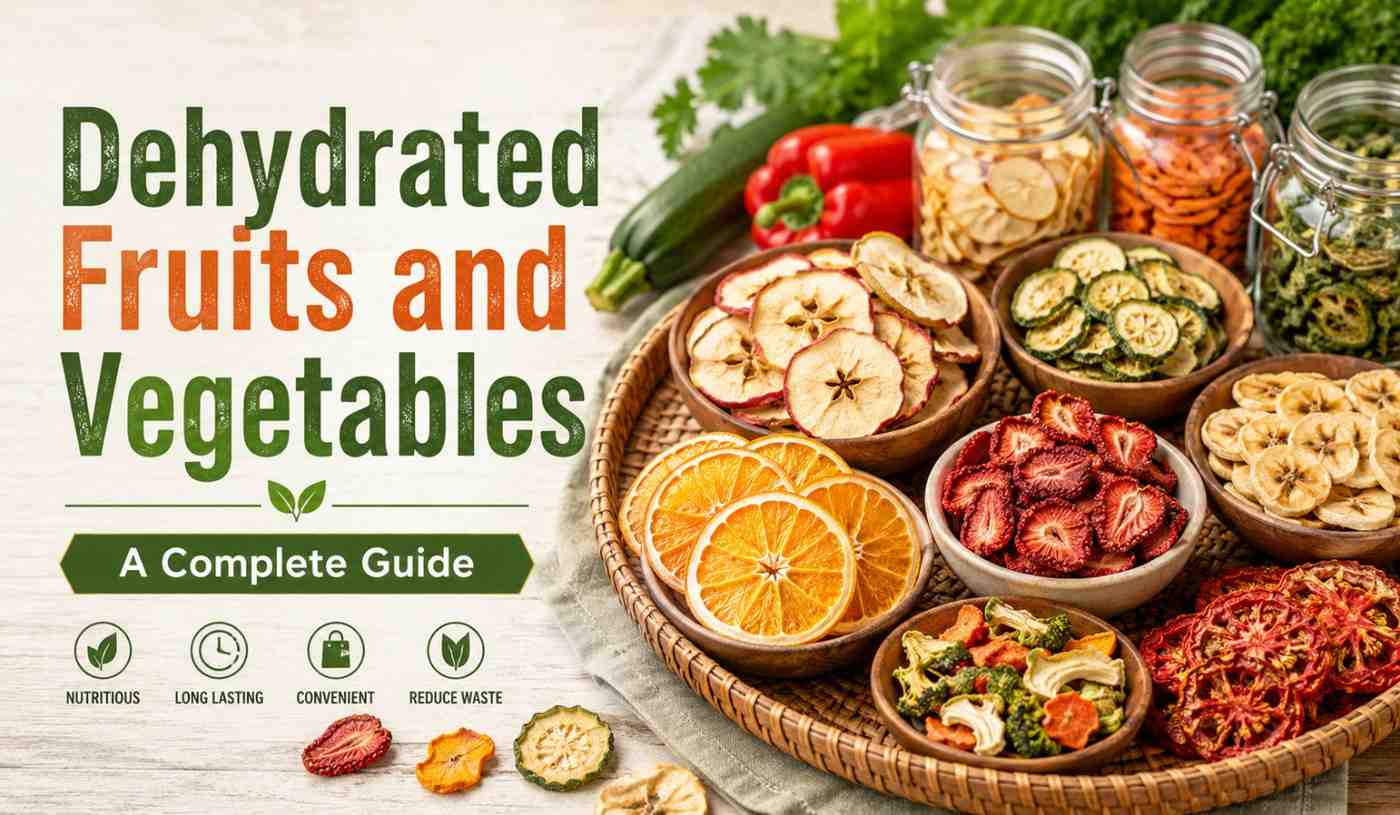
Dehydration is one of humanity’s oldest food preservation methods, predating refrigeration by thousands of years. Today it’s also one of the fastest-growing segments of the global food industry – the dehydrated fruits and vegetables market was valued at roughly USD 54.85 billion in 2024 and is projected to climb past USD 94 billion by 2033, growing at a CAGR of around 6.35%, driven largely by demand for shelf-stable, clean-label, plant-based snacking options.
This guide breaks down exactly how fruits and vegetables are dehydrated, what actually happens to their nutrients during the process, how to evaluate quality when buying, and how to store dried produce so it lasts. Whether you’re a home cook stocking a pantry, a retailer sourcing from manufacturers, or just curious about the science, this is meant to be the most thorough resource you’ll find on the topic.
What Is Dehydration, Exactly?
Dehydration is the controlled removal of water from food under regulated conditions of temperature, humidity, and airflow. Fresh produce typically holds more than 80% water by weight, which is exactly why it spoils so quickly – that moisture is a breeding ground for bacteria, yeast, and mold. By pulling most of that water out, dehydration lowers what food scientists call “water activity,” making the environment inhospitable to spoilage organisms.
The benefits go beyond shelf life. Removing water also:
- Cuts weight and volume by 80–90%, which significantly reduces packaging, freight, and warehousing costs
- Concentrates flavor and natural sugars, which is why dried fruit often tastes sweeter than fresh
- Reduces food waste by letting surplus harvests be preserved instead of discarded
- Extends usability of seasonal produce year-round
Step 1: Pre-Drying Treatments
Before any moisture is removed, raw produce goes through a preparation stage that determines the final color, texture, and food-safety profile of the product.
Sorting and grading. Fruits and vegetables are sorted by size and ripeness so that drying time can be calculated consistently – uneven pieces dry unevenly, which creates quality and safety inconsistencies in the final batch.
Washing. Produce is thoroughly washed to remove dirt, plant debris, insects, and mold spores that could otherwise affect color, aroma, or flavor, or introduce pathogens.
Peeling. Not every fruit is peeled. Apples, bananas, pineapples, and pears are commonly peeled because their skins can toughen or discolor during drying. Most vegetables have undesirable outer layers removed during washing.
Cutting. Produce is cut into uniform shapes and thicknesses – slices, dices, or strips – so it dries evenly and at a predictable rate.
Blanching. Many vegetables are briefly blanched (a short dip in hot water or steam) before drying. This deactivates enzymes that would otherwise continue ripening or browning the food, helping preserve color and nutritional quality once drying begins.
Dipping (for waxy fruits). Fruits with a natural waxy coating, like grapes and plums, are sometimes dipped in a mild alkali (lye) solution to break down that coating, which speeds up moisture loss during drying.
Color preservation. Many light-colored fruits – apricots, apples, and golden raisins, for instance – are treated with sulfur dioxide or sulfites before drying. This prevents enzymatic browning and acts as a mild antioxidant. It’s worth noting for consumers: sulfite-treated products must be labeled, since some people have a sensitivity to sulfites. Brands that market “unsulfured” dried fruit use alternative methods like ascorbic acid (vitamin C) dips or simply accept a darker final color.
Step 2: The Dehydration Process
This is the core stage where the bulk of water is removed. There isn’t one single “correct” method – the choice depends on the produce type, desired shelf life, cost constraints, and quality target. The main methods used commercially are:
| Method | How It Works | Typical Use | Trade-offs |
| Sun/solar drying | Produce is spread out and dried using direct sunlight and ambient airflow | Apricots, raisins, chilies, tomatoes in warm climates | Slowest, weather-dependent, higher contamination risk if not screened |
| Hot-air/convective drying | Heated air is circulated through tunnels, cabinets, or conveyor dryers | Most commercial vegetable dehydration (onion, carrot, garlic, cabbage) | Fast and cost-effective, but higher heat can degrade heat-sensitive vitamins |
| Vacuum/sub-atmospheric drying | Drying occurs at reduced air pressure, lowering the boiling point of water so moisture evaporates at much lower temperatures | Delicate fruits, herbs, premium products | Better nutrient and color retention than hot-air drying, more expensive |
| Freeze-drying (lyophilization) | Food is frozen, then moisture is removed via sublimation under vacuum, skipping the liquid phase entirely | Premium fruit snacks, instant soups, baby food, space/military rations | Highest nutrient retention (often 90–98%) and best texture, but significantly costlier per kilogram |
| Osmotic dehydration | Produce is soaked in a concentrated sugar or salt solution that draws water out before final drying | Pretreatment for tropical fruits (mango, pineapple) | Improves texture and reduces energy use in the final drying step |
Recent food-science research has also focused heavily on non-thermal pretreatments – including pulsed electric fields, ultrasound, and cold plasma – applied before drying to improve cell permeability. These techniques can shorten drying time and improve final texture without the heat damage associated with traditional blanching, and they represent one of the more active areas of dehydration research as of 2026.
Step 3: Post-Dehydration Treatments
Once moisture has been removed to the target level (usually between 5–25% residual moisture depending on the product), several finishing steps follow:
- Sweating/conditioning: Dried pieces are held in bins so that any remaining moisture redistributes evenly across the batch, preventing some pieces from being over-dry and others under-dry.
- Screening and sorting: Oversized, undersized, or discolored pieces are removed to maintain consistent quality.
- Instantization treatments: Some products are treated to improve how quickly they rehydrate when added to water – important for instant soup mixes and ready meals.
- Packaging: This is arguably the most important step for shelf life. Moisture-barrier packaging (often combined with nitrogen flushing or vacuum sealing) prevents the product from reabsorbing ambient humidity, which is the single biggest cause of spoilage and mold growth in dried foods after they leave the factory.
Does Dehydration Destroy Nutrients?
This is the question most people actually want answered, so let’s get specific.
The short version: dehydration is one of the gentler preservation methods for nutrient retention – but it isn’t lossless, and the degree of loss depends heavily on the drying method and temperature used.
- Fiber, minerals, and calories are essentially unaffected. Because fiber and minerals aren’t broken down by heat or oxygen exposure the way vitamins are, dried fruit typically has the same fiber, protein, and mineral content as fresh fruit – just concentrated into less volume. This is actually why a small handful of dried apricots delivers noticeably more fiber than the same weight of fresh apricots.
- Heat-sensitive vitamins take the biggest hit. Vitamin C, certain B-vitamins, and beta-carotene are volatile and degrade with prolonged heat exposure. Conventional hot-air drying can result in vitamin C losses of 60–80% in some produce, while gentler methods like vacuum drying or freeze-drying typically retain 90% or more.
- Freeze-drying outperforms standard dehydration on nutrient retention. Because freeze-drying removes water via sublimation rather than evaporation, it never exposes the food to high heat. Studies generally show freeze-dried produce retaining 90–98% of original nutrients, compared to roughly 60–80% for conventionally hot-air dried produce.
- Fresh isn’t automatically superior. This is the part most articles miss: fresh produce is not nutritionally “frozen in time” the moment it’s picked. It continues to lose vitamins during transport and storage – research has shown fresh produce can lose up to 50% of certain vitamins and antioxidants within just a few days of refrigeration. A properly dried product bought today may, in practice, contain more usable nutrition than a “fresh” vegetable that’s been sitting in cold storage and transit for a week.
- Sugar concentration is a real consideration. Removing water concentrates natural sugars, so dried fruit is calorically denser by weight than fresh fruit, and it’s easy to eat a much larger effective “fruit equivalent” in one sitting. Moderation matters more with dried fruit than fresh.
Bottom line: if nutrient retention is your top priority, look for vacuum-dried or freeze-dried products, or products that specify low-temperature drying. If cost and shelf-stability matter more, conventional hot-air dehydrated produce is still a nutritionally solid choice – just not nutrient-identical to fresh.
Dehydrated vs. Freeze-Dried: What’s the Difference?
People often use these terms interchangeably, but they’re genuinely different processes with different end results.
| Conventional Dehydration | Freeze-Drying | |
| Process | Heat + airflow evaporates water | Freezing + vacuum sublimates water |
| Texture | Chewy, leathery | Light, crisp, crunchy |
| Nutrient retention | ~60–80% | ~90–98% |
| Shelf life | Months to 1+ year | 1–2+ years (often longer) |
| Cost | Lower | Significantly higher |
| Rehydration | Slower | Near-instant |
| Best for | Snacking, baking, cost-sensitive bulk use | Premium snacks, instant meals, emergency food, baby food |
Neither is objectively “better” – it depends on your priority. If you want an affordable chewy snack or an ingredient for cooking, conventional dehydrated produce works well. If you want maximum nutrient retention, crisp texture, or long-duration storage (such as for emergency preparedness or backpacking), freeze-dried is generally worth the premium.
How to Choose Quality Dehydrated Produce
When buying dried fruits or vegetables, whether for home use or wholesale sourcing, a few quality markers matter:
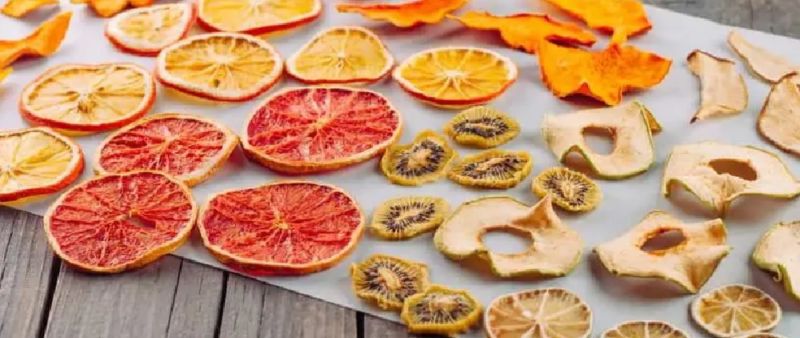
- Check the ingredient list. A product should ideally list just the fruit or vegetable itself. Watch for added sugar, oil, or sulfites if you’re avoiding them – and remember sulfites must be disclosed on the label by regulation in most countries, including India and the US.
- Look at color consistency. Uniform color across pieces usually indicates controlled drying conditions. Excessive browning can indicate poor blanching or oxidation during processing.
- Smell test. Properly dried produce should smell like a concentrated version of the fresh item – not musty or stale, which can indicate moisture re-absorption or age.
- Check the packaging. Vacuum-sealed or nitrogen-flushed pouches protect against moisture and oxidation far better than simple poly bags.
- Ask about the drying method if buying in bulk or from a manufacturer. Reputable suppliers will tell you whether their product is sun-dried, hot-air dried, vacuum-dried, or freeze-dried, and at what approximate temperature – this directly affects both nutrition and shelf life.
Storage Tips for Maximum Shelf Life
Dried produce is shelf-stable, but “shelf-stable” doesn’t mean “indestructible.” To get the longest usable life out of dehydrated fruits and vegetables:
- Keep it airtight. Use resealable, moisture-proof containers or vacuum-sealed bags. Every time air gets in, ambient humidity starts working against your product.
- Store in a cool, dark place. Heat and light both accelerate nutrient degradation and rancidity, especially in dried produce with any natural oil content (like dried mango or coconut).
- Use desiccant packets for bulk storage. Especially useful in humid climates, including most of India during monsoon season.
- Refrigerate or freeze for very long-term storage. While not strictly necessary for short-term use, cold storage can extend shelf life significantly for bulk-purchased dried goods.
- Inspect before use. Discard anything showing visible mold, an off smell, or clumping that suggests moisture has re-entered the package.
Common Uses in the Kitchen
Dehydrated fruits and vegetables aren’t just snacks – they’re functional ingredients:
- Snacking: dried mango, banana chips, apple rings, dried berries
- Baking: raisins, dried cranberries, candied ginger in cakes and cookies
- Soups and instant meals: dehydrated onion, carrot, peas, and mushrooms rehydrate quickly in broth
- Trail and travel food: lightweight, calorie-dense, and shelf-stable – ideal for hiking, camping, and travel
- Spice blends and seasoning bases: dehydrated garlic and onion powder are pantry staples
- Garnishes: dried tomato, beet, or citrus slices for plating and presentation
Frequently Asked Questions
Largely, yes – fiber, minerals, and calories remain essentially intact. Some heat-sensitive vitamins (notably C and certain B-vitamins) are reduced, with the degree of loss depending on the drying method. Freeze-dried and vacuum-dried produce retain more vitamins than conventional hot-air dried produce.
Not necessarily – but check labels. Plain dried fruit has no added sugar; the sweetness comes from concentrated natural sugars. Some commercial brands add sugar or oil coatings, so reading the ingredient panel matters.
Properly dried and sealed vegetables typically last 6–12 months at room temperature, and considerably longer if vacuum-sealed or refrigerated. Freeze-dried versions can last several years unopened.
Color changes are usually due to natural oxidation (browning) if the fruit wasn’t treated with sulfur dioxide or an antioxidant like ascorbic acid before drying. It’s a cosmetic difference, not necessarily a safety issue.
Yes – a home food dehydrator, or even a low-temperature oven, can dry most produce. Home drying generally uses lower precision than commercial equipment, so consistency and shelf life may vary; following USDA or equivalent food-safety guidelines for blanching and drying temperatures is recommended for safety.