What Industries Use Heavy Centrifugal Blowers the Most?
KEY TAKEAWAYS
- Heavy centrifugal blowers move high pressure air or gases in industrial systems.
- Power plants rely on them for combustion air supply.
- Cement factories use them for dust control and airflow management.
- Steel plants depend on blowers for furnace air supply and cooling.
- Chemical industries use them to move gases safely through processing units.
- Food processing facilities use them for drying and airflow control.
- Wastewater plants use blowers to supply oxygen for biological treatment.
- Mining operations rely on them for underground ventilation.
- Textile factories use them to remove lint and maintain clean airflow.
- Oil refineries use heavy centrifugal blowers to move gases through refining systems.
Have you ever wondered why many factories rely on heavy centrifugal blowers to keep their operations running smoothly?
If you work around manufacturing, power plants, or processing industries, you might hear this term often. But what exactly are heavy centrifugal blowers? Why are they used in so many industrial environments? And which industries depend on them the most?
To understand this clearly, we need to start with the basics.
These blowers are industrial machines that move large volumes of air or gas using rotating impellers. When the impeller spins, it pulls air into the center and pushes it outward with strong force.
The simple reason industries use them is reliability. These blowers handle high pressure, high temperature, and continuous operation without stopping.
Once you understand how they work, the next question becomes obvious. Which industries actually use them the most?
Let’s break that down in a clear and practical way.
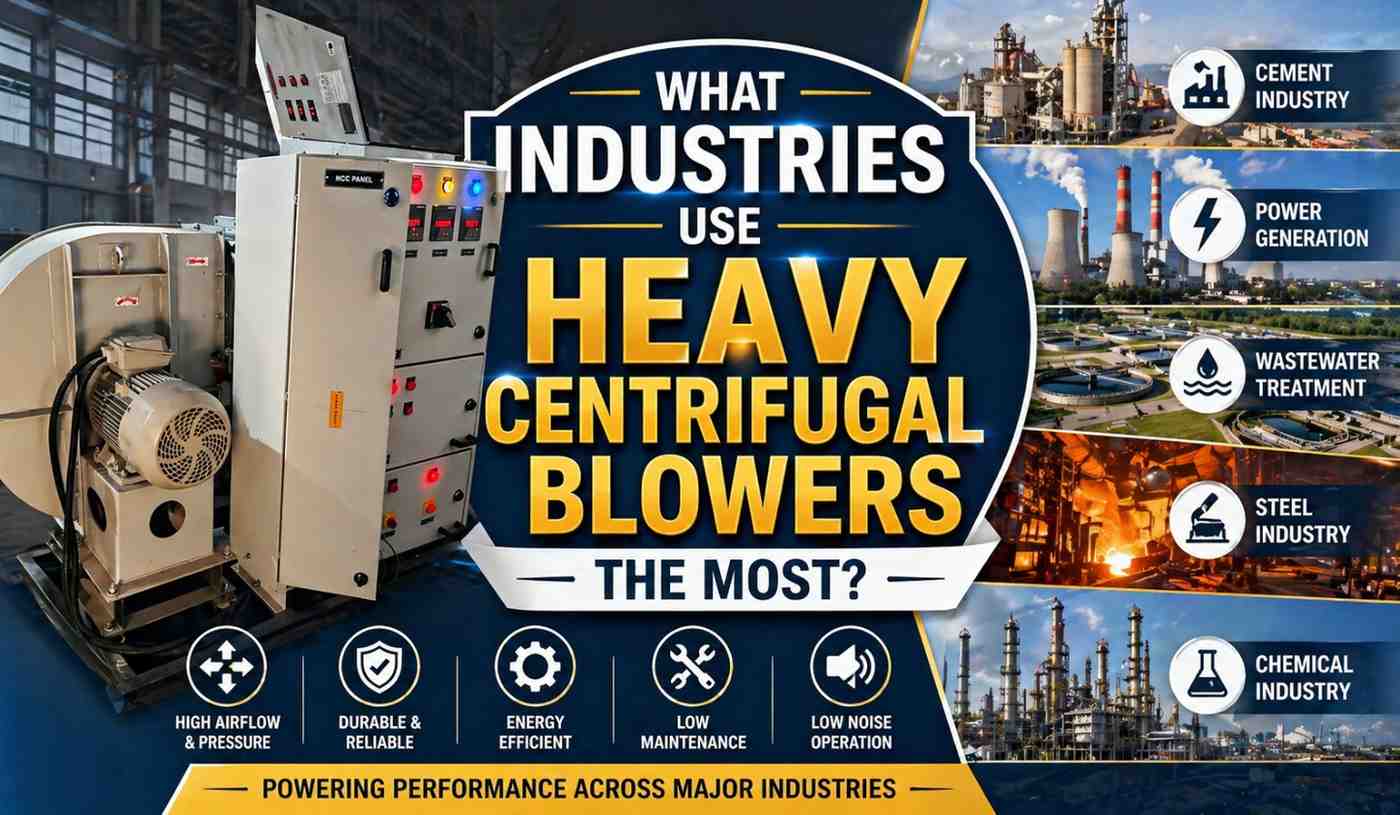
TOP 10 INDUSTRIES THAT USE HEAVY CENTRIFUGAL BLOWERS THE MOST
Power Generation Plants
Power plants are one of the biggest users of heavy centrifugal blowers.
Thermal power plants rely on them for combustion air supply. Boilers need a continuous flow of air to burn fuel properly. Centrifugal blowers push high pressure air into the combustion chamber so that coal or other fuels burn efficiently.
Cement Manufacturing Industry
Cement plants generate large amounts of dust and heat during production.
They help control dust and maintain airflow across various stages such as raw mill processing, kiln operations, and clinker cooling. These blowers move large volumes of air to remove hot gases and dust particles.
Steel and Metal Processing Plants
Steel plants operate under extremely high temperature conditions.
They are used to supply oxygen rich air to furnaces. This airflow supports combustion processes needed to melt metals. Furnaces require constant airflow pressure to maintain stable temperatures.
Chemical Processing Industry
Chemical factories rely on controlled airflow for many reactions.
They move gases through reactors, scrubbers, and chemical processing systems. These blowers help circulate gases, maintain pressure levels, and remove harmful vapors from production areas.
Food Processing Industry
You might not expect this, but food processing plants also use heavy centrifugal blowers.
These blowers are commonly used in drying systems. Many food products such as grains, spices, and packaged snacks require controlled airflow for drying and cooling.
Wastewater Treatment Plants
Wastewater treatment plants depend heavily on-air supply systems.
They provide oxygen to biological treatment tanks. Microorganisms inside these tanks break down organic waste. They need a continuous supply of oxygen to function effectively.
Mining Industry
Mining operations generate large amounts of dust and harmful gases underground.
They are used in mine ventilation systems. They push fresh air into tunnels and remove contaminated air.
Textile Manufacturing Industry
Textile mills require proper airflow for several production processes.
Blowers help remove lint, dust, and fibers produced during spinning and weaving operations. This keeps machinery clean and reduces fire risks.
Pharmaceutical Manufacturing
Pharmaceutical factories operate under strict air quality standards.
They support clean room ventilation systems. They help circulate filtered air and maintain pressure control between different production areas.
Petrochemical and Oil Refineries
Oil refineries process large volumes of gases and vapors.
They help move gases through refining units, gas treatment systems, and combustion processes. They are also used in flare systems and vapor recovery units.
LAST WORDS
Heavy centrifugal blowers and industrial axial flow fans play a critical role in many industrial operations. The important thing to understand is that different industries use these blowers for different reasons. Some need them for safety, some for production efficiency, and others for environmental control.
FAQs
Industries rely on them for ventilation, cooling, dust control, combustion air supply, and maintaining safe working environments.
They are commonly used in industrial boilers, furnaces, pollution control systems, pneumatic conveying, drying processes, and material handling systems.
Yes, many heavy centrifugal blowers are designed to handle high temperatures and harsh industrial conditions.
Heavy centrifugal blowers offer reliable airflow, high efficiency, and long operational life.
Industries should check airflow capacity, pressure requirements, energy efficiency, material durability, maintenance needs, and compatibility with existing systems.
Heavy centrifugal blowers help move contaminated air through filtration systems, dust collectors, and scrubbers.
Yes, power plants frequently use heavy centrifugal blowers to supply combustion air, remove flue gases, and maintain proper ventilation.
Yes, selecting a trusted manufacturer ensures better engineering quality, strong materials, efficient airflow performance, and long-term reliability.
They are typically installed in production areas, boiler rooms, pollution control systems, ventilation systems, and process equipment where controlled airflow and pressure are necessary for industrial processes.