Types of Wedding Bands for Women
Choosing the right wedding band for a woman is harder than it used to be – not because good options are scarce, but because there are now more of them than ever. Metal choices, stone-setting techniques, sustainable sourcing, and personalization options have all expanded rapidly over the last few years. Add in the rise of stackable bands and lab-grown diamonds reshaping the price-to-quality equation, and even seasoned jewelry shoppers can feel overwhelmed.
This guide breaks down the styles that matter most in 2026, what makes each one distinct, and how to think about choosing between them – whether you’re shopping for yourself, planning a proposal, or helping a partner narrow things down.
Why There Are So Many Options Now
Wedding jewelry has moved away from a “one design fits everyone” approach. Three shifts are driving this:
- Lab-grown diamonds are mainstream. They now account for a significant share of engagement and wedding ring sales worldwide, making intricate stone-set designs (like eternity bands) far more affordable than they were a decade ago.
- Stacking culture. Many women no longer wear a single band – they layer a classic band with a contour or curved band to create a custom look over time.
- Recycled and traceable metals. Recycled gold and platinum, along with lab-grown stones, have become a standard request rather than a niche one, as buyers pay closer attention to sourcing.
With that context, here are the styles worth knowing.
1. The Carved Band
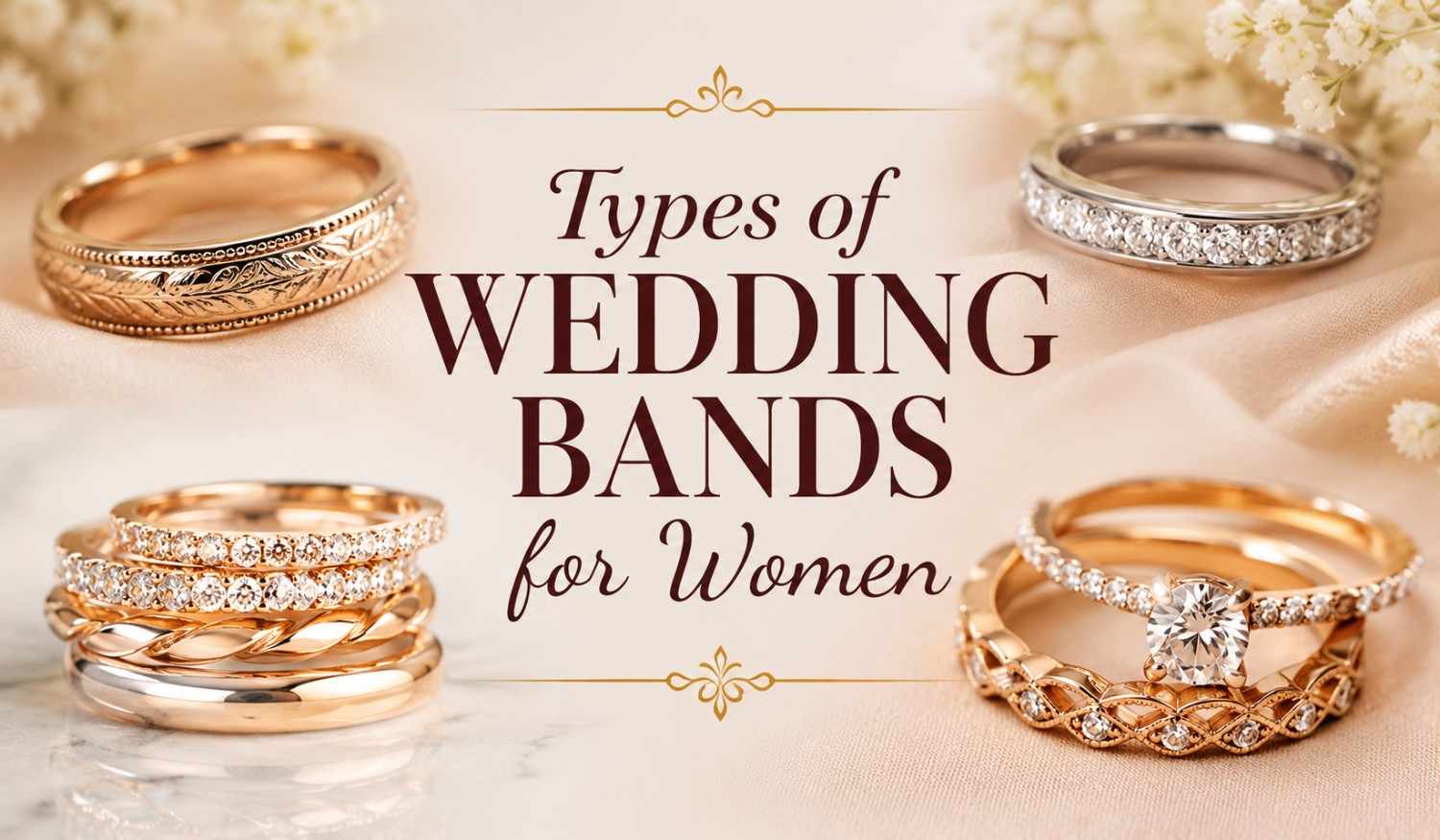
The carved band remains a favorite for women who want something more distinctive than a plain metal ring without going fully into gemstone territory. It gets its name from the engraved detailing cut directly into the metal – motifs, filigree patterns, milgrain edging, or botanical designs.
What makes it stand out today: Laser and micro-engraving technology has made highly detailed, personalized carving (initials, dates, fingerprints, even a partner’s handwriting) far more precise and accessible than traditional hand-engraving allowed. This has made carved bands one of the most requested “customizable” styles.
Best for: Women who want an artistic, one-of-a-kind ring without a large stone.
2. The Three-Stone Wedding Ring
The three-stone ring places three stones side by side, traditionally symbolizing a couple’s past, present, and future together. It strikes a balance between meaningful symbolism and understated sparkle.
What’s changed: Rather than uniform round stones, many 2026 designs mix cuts and sizes – an oval center stone flanked by two smaller pear or baguette stones – for a more architectural, less matchy look. Mixed-metal settings (white gold prongs on a yellow gold band, for instance) have also grown popular for the same reason.
Best for: Couples who want their ring to carry a story, not just aesthetic appeal.
3. The Eternity Wedding Band
Eternity bands are fully (or near-fully) set with stones around the entire circumference, symbolizing an unbroken, everlasting union. It remains one of the most photographed and sought-after styles for its consistent sparkle from every angle.
What’s new: Full eternity settings – once reserved for special-occasion budgets – are now widely available in lab-grown diamonds and moissanite, cutting costs substantially while keeping the same visual impact. Half-eternity bands (stones on the top half only) have also grown popular as a practical option for women with active hands or manual jobs, since the plain underside sits flush and resists snagging.
Best for: Women who want maximum sparkle and a symbolic statement of permanence.
4. The Classic Wedding Band
The plain metal band remains the most universally worn wedding ring across generations, and for good reason: it never clashes, never dates, and pairs with virtually anything.
Why it still works in 2026: Its simplicity is exactly what makes it flexible. A classic band can later be upgraded – stones added, an eternity band stacked beside it, or an anniversary band layered on top – without ever needing to be replaced. This flexibility has made it a common “safe but smart” choice, especially for surprise proposals where the giver isn’t certain of exact preferences.
Best for: Anyone who wants longevity, versatility, and the option to personalize later.
5. The Stackable / Contour Band
A style that has grown sharply in relevance since earlier versions of this guide: the stackable or contour band. Designed to sit flush against an engagement ring’s curve, contour bands follow the outline of the center stone rather than sitting as a straight circle.
This trend has grown alongside the broader stacking movement – where women build a personalized “ring stack” over years, adding anniversary bands, birthstone bands, or curved companion bands one at a time. Its practical appeal is that it prevents gapping between the engagement ring and wedding band, keeping the whole set secure and comfortable.
Best for: Pairing with a solitaire or unusually shaped engagement ring, or for those who want their ring collection to evolve over time.
How to Choose: A Quick Decision Framework
| Priority | Best Style |
| Wants maximum flexibility | Classic band |
| Wants symbolism built in | Three-stone ring |
| Wants maximum sparkle | Eternity band |
| Wants a unique, artistic touch | Carved band |
| Has (or plans to add) other rings | Stackable/contour band |
| Active job or hands | Half-eternity or classic band |
A practical tip: if you’re buying as a surprise, ask indirectly first – check what she already wears daily (delicate vs. bold, gold vs. platinum) rather than guessing. Retailers increasingly offer free resizing and a “trade-up” program within the first year, so it’s worth confirming this before purchase, since ring size and taste can shift after the wedding.
Final Thoughts
The best wedding band isn’t necessarily the newest trend or the most traditional option – it’s the one that matches how she actually lives, works, and dresses day to day. If in doubt, the classic band remains the safest starting point precisely because it can be built on later, while eternity and three-stone rings suit those who already know they want more sparkle or symbolism from day one.
Frequently Asked Questions
Classic plain bands and half-eternity bands remain the two most consistently popular choices, largely because they offer everyday comfort along with the flexibility to add stones or stack additional rings later.
Yes. Lab-grown diamonds are chemically and visually identical to mined diamonds but typically cost 30-50% less, which has made stone-heavy styles like eternity and three-stone bands significantly more accessible without compromising on brilliance or durability.
Absolutely. Many women wear their wedding band as a standalone daily ring, especially classic or carved styles, saving eternity or stacked designs for special occasions or later additions.
Borrow an existing ring she wears on the correct finger and have it sized at a jeweler, or check her online shopping history for size hints. Most reputable jewelers also offer one free resizing within the first year to cover any guesswork.
Platinum and 14k-18k white or yellow gold are the most durable everyday choices. Platinum resists tarnishing and holds stones securely, while 14k gold offers a good balance of durability and affordability for daily wear.